Hello! I’m Niall Horn, a 29-year-old guy (not to be confused with Niall Horan, though you wouldn’t be the first!).
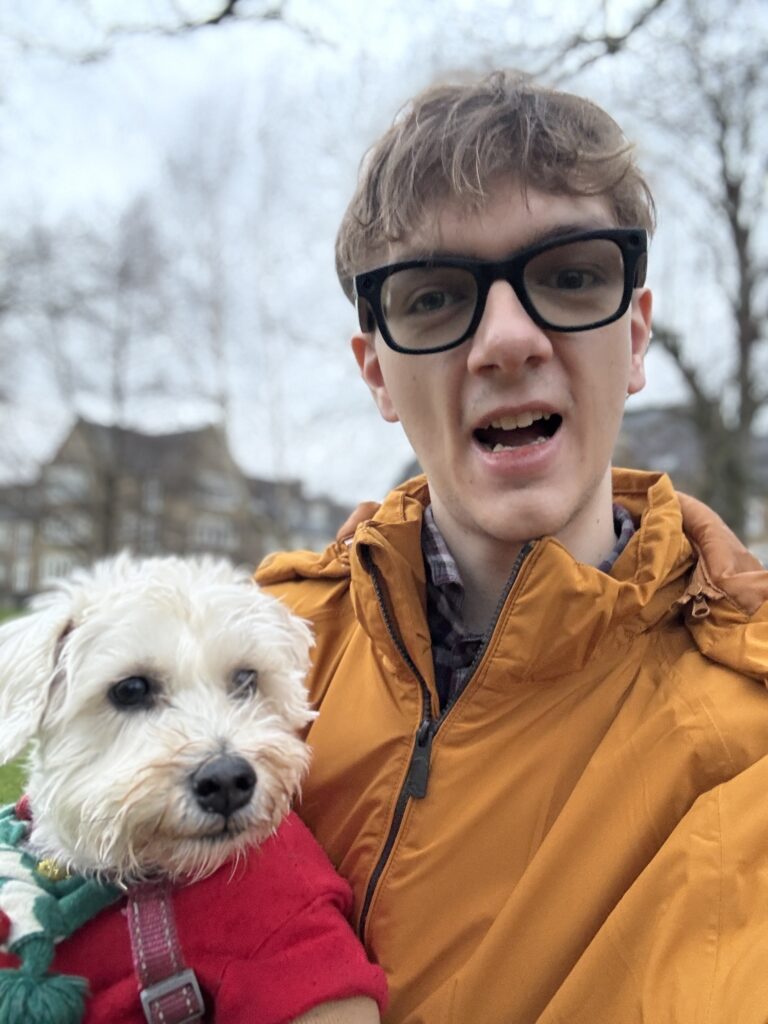
I’m from and currently live in Great Ayton, a village in North Yorkshire, UK. Whilst it is very green and somewhat quiet, it’s not the most obvious place to build a career in VFX or research engineering; my doggo Lucy may disagree!
Early Years
From a young age, I’ve been drawn to technical, procedural, and systems-driven thinking. That curiosity showed up in different forms over time, with a common theme of simulation: magic, theme-park engineering, military systems and tactics, flight simulators… but it eventually converged on film and technology. A childhood interest in filmmaking led to a particularly strong interest in stop-motion animation (Aadrman), which in turn led me toward computer graphics after being inspired by films like Star Wars (especially Empire!) and Shrek 2 (well, all of them, but 2 is the best).
As I got older, that interest sharpened into a focus specifically on visual effects. Films like Peter Jackson’s King Kong (2005) and Michael Bay’s Transformers series were formative, becoming religious viewing, with an eye especially for the visual effects work. Like many, I spent even more time, however, watching DVD special features, trying to understand how these worlds were built rather than just enjoying the finished result! This spiralled into an addiction to Cinefex and 3D World Magazine!
Teenage Years – Escapism into VFX and Cinema
As my teenage years progressed past 14, filmmaking and visual effects became more than just an interest. They became a way to escape into something structured and controllable. I started small, making Star Wars-inspired shorts in my garden using tools like FXHome’s VisionLab Pro and Adobe’s After Effects, learning almost entirely through trial and error on a slow pc with 1GB of RAM! What mattered to me wasn’t polish, but understanding how things worked.
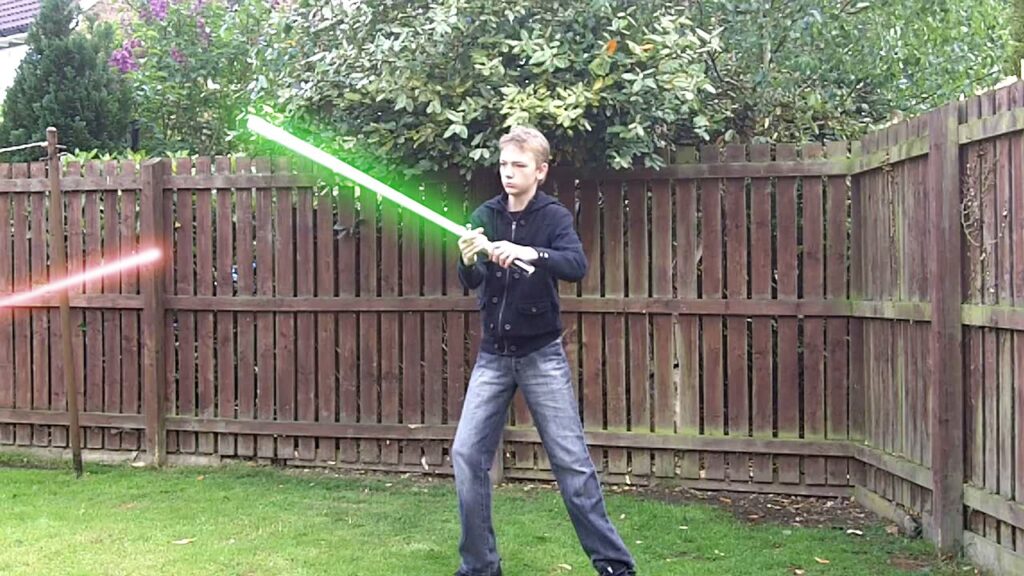
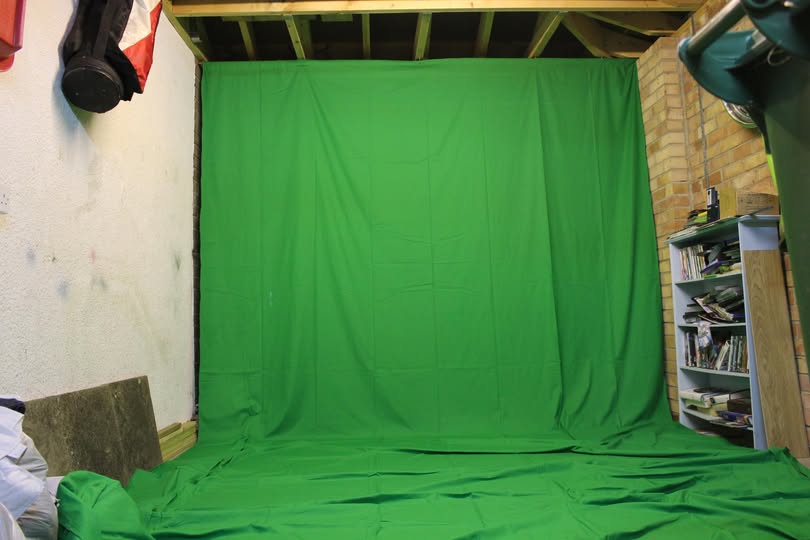
Over time, that experimentation grew into more ambitious projects. I started learning camera tracking / matchmoving, more advanced compositing and the full 3D pipeline. With the support of a few very kind people, I wrote, directed, and produced several short films of my own, handling visual effects, cinematography, and editing.
This started with a short action film I made in January 2012, when I was 14, on a local airsoft site. I’m very thankful to the awesome people who turned up to help me 🙂 We shot a cool film at an awesome location and I went home and spent the next week hyper-focused on VFX and editing!
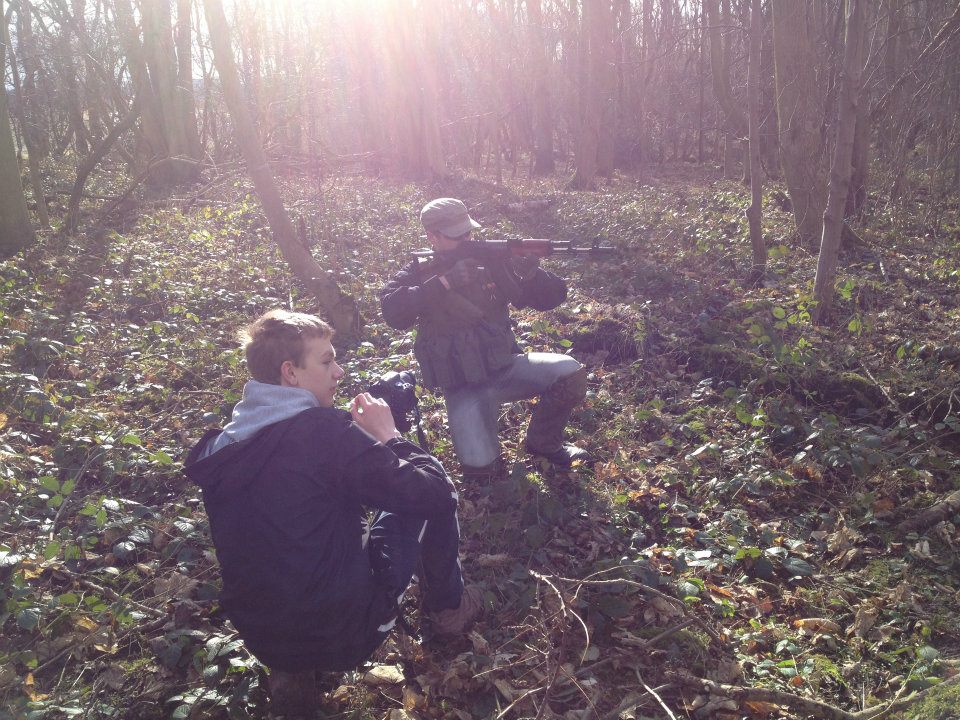
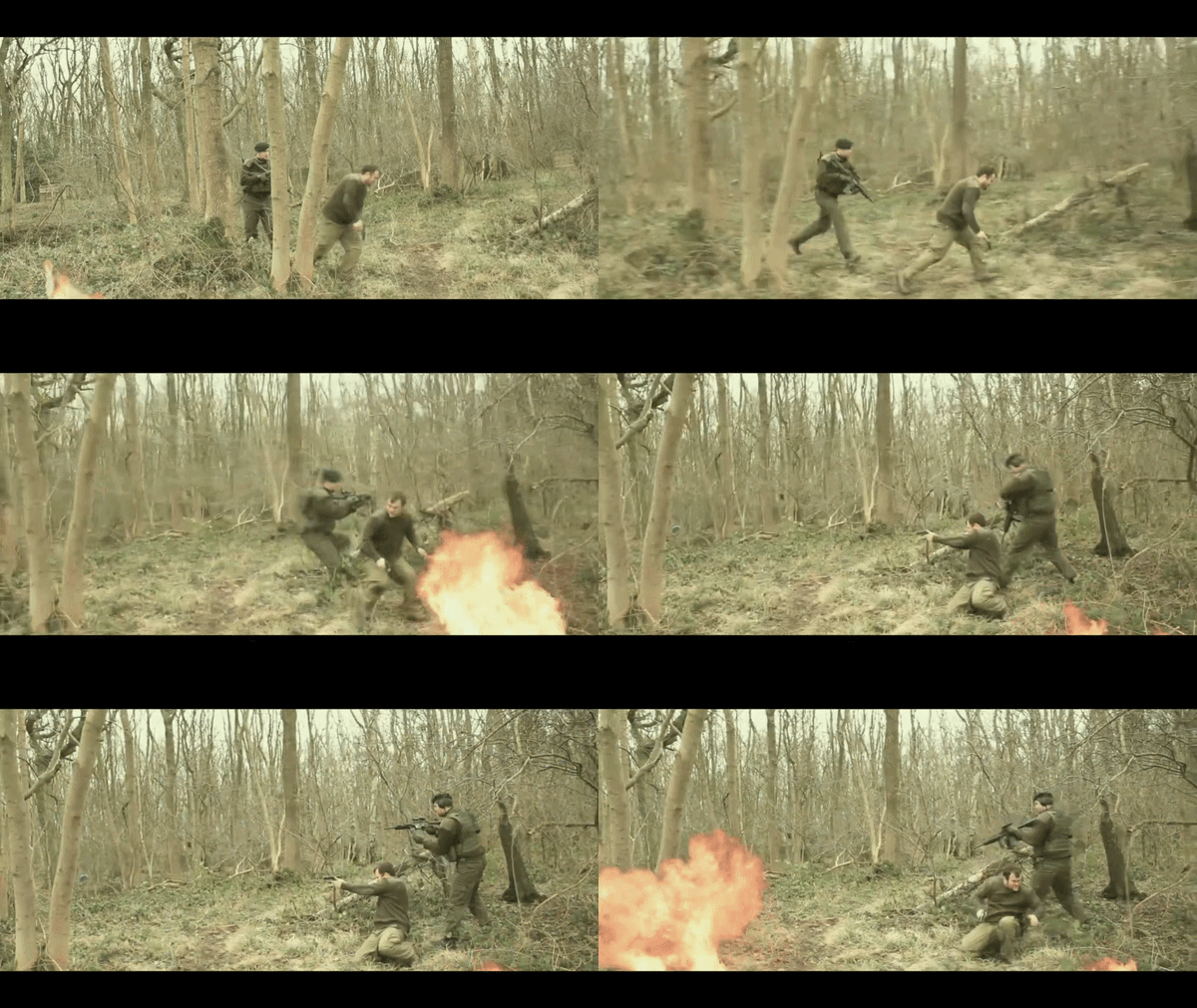
A camera tracking nightmare for a 14-year-old VFX n00b! — (no distortion grids, no stabilisation, rolling shutter galore) 😂🔥
Later on, I got to work on a small World War II–themed short made in collaboration with a local re-enactment group. This was complete with live pyrotechnics, and I was living the dream! It was chaotic, imperfect, and unforgettable. I dedicated that film to my grandfather and the Royal British Legion.
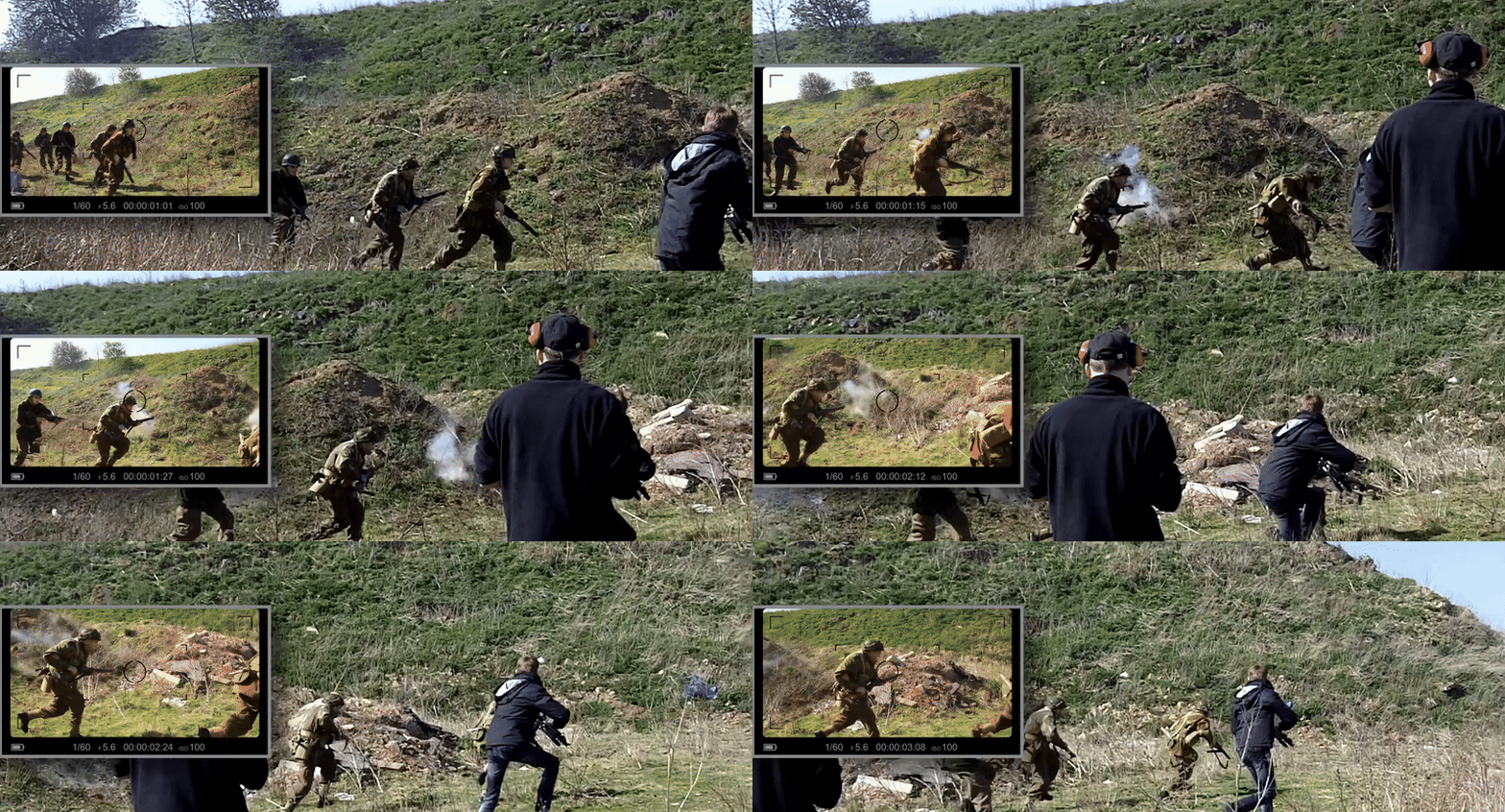
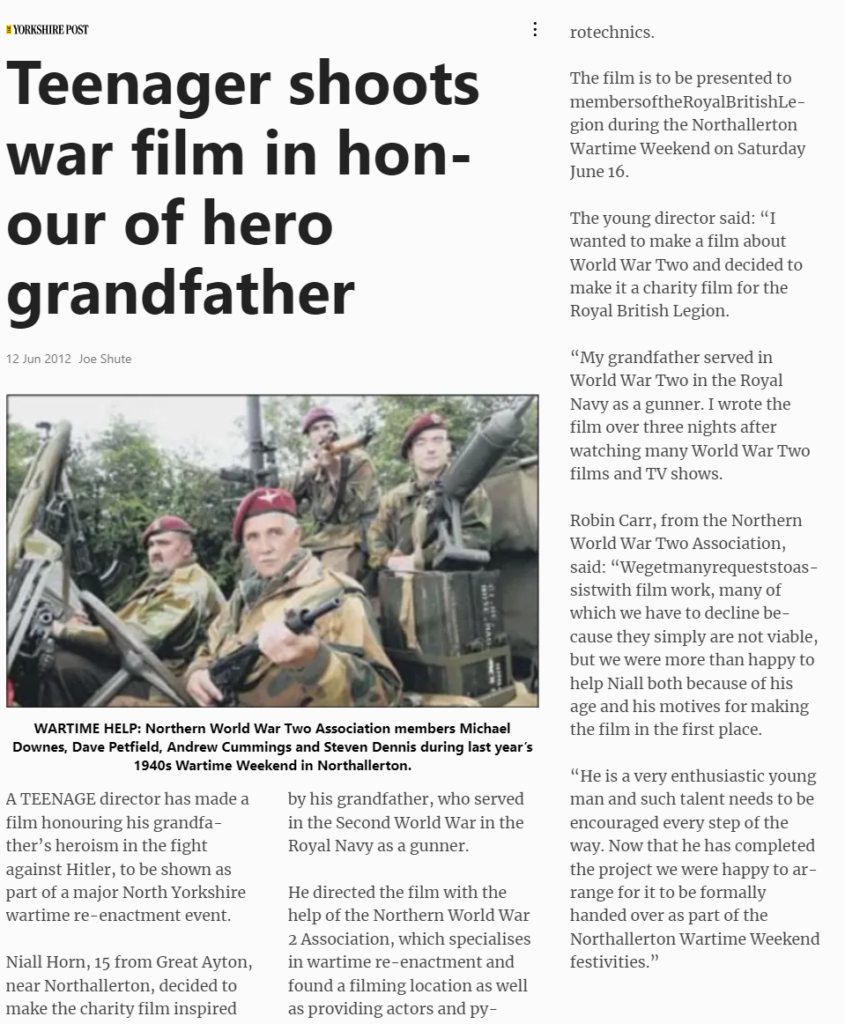
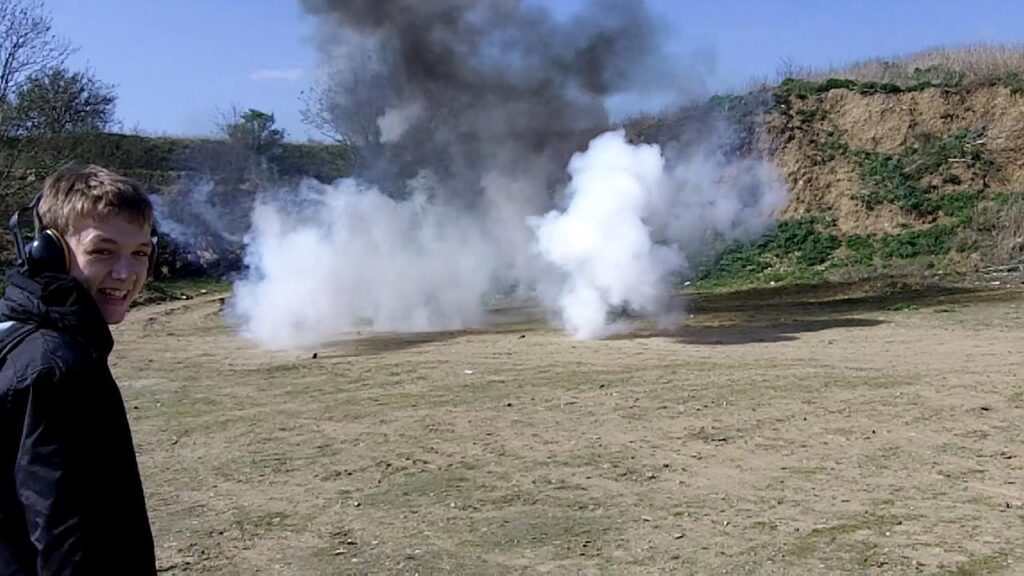
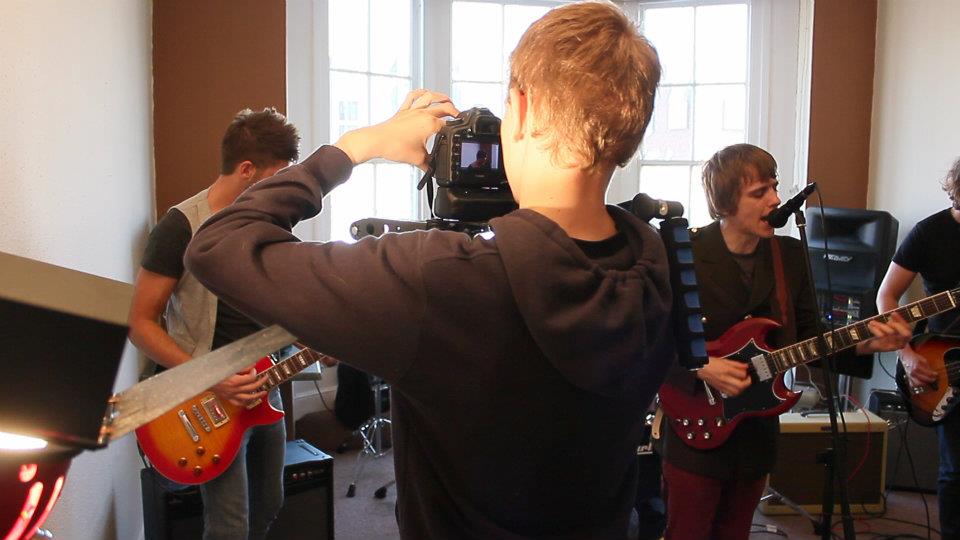
Heading into summer 2012, I worked with a local videographer on music videos and wedding films, learning practical cinematography and how to operate under real-world constraints. Rather than engaging in the social landscape of a wedding, I was in hyperfocus trying to find the right ND filters, pushing the limits of low-bit-rate DSLR video!

While my interests deepened, my day-to-day life became more isolated because of my physical and mental health (later attributed to genetic and neurodevelopmental disorders). I missed significant parts of school (exams/finals), and conventional education slowly stopped being the structure around which my life was organised. When I was in school, I wasn’t exactly popular, bullied for my interests, which somewhat deviated from the expected teenager in a British secondary school and concurrently outcast from the general crowd due to my disabilities, spending a lot of my time segregated in order to cope. Luckily, at the time, I had a small core group of friends and my brother, who kept me grounded and helped get me through.
In order to survive these years, I lived most of my teenage years on a mix of psychotropics and antibiotics, both of which led to detrimental side effects on a daily basis. I attended multiple weekly health appointments, which led to a revolving door of poorly understood diagnoses that nothing seemed to resolve, and my symptoms were getting worse. My planned trajectory to my dream career was under threat, and I became more housebound. I was barely in school in my last year, and when I was, it was half days, medicated, and requiring help to get over the finish line. I went from taking one subject a year early and earning an A* in one subject to getting D-Fs within a single term. Ultimately, I left as an all-C student. I never even took a math exam, but I did pass physics, though!
By the time I was 16, what replaced an unstable conventional environment was an isolated but expanded and highly intense focus on the things I could work on in my bedroom. I spent most of my time teaching myself more advanced visual effects techniques, delving into physics simulation, posting work online, getting feedback, and iterating. I also had a side quest into game modding, which turned out to be an early lesson in coding and systems thinking, where rules, constraints, and code interact to show how small changes can ripple through the end user experience.
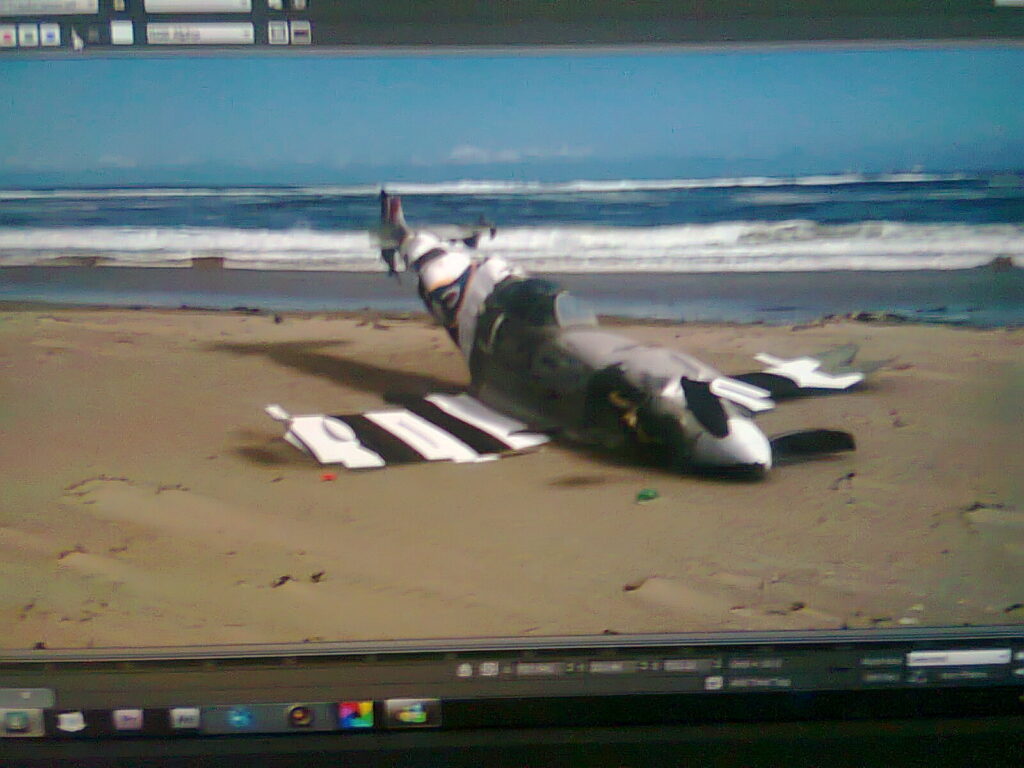
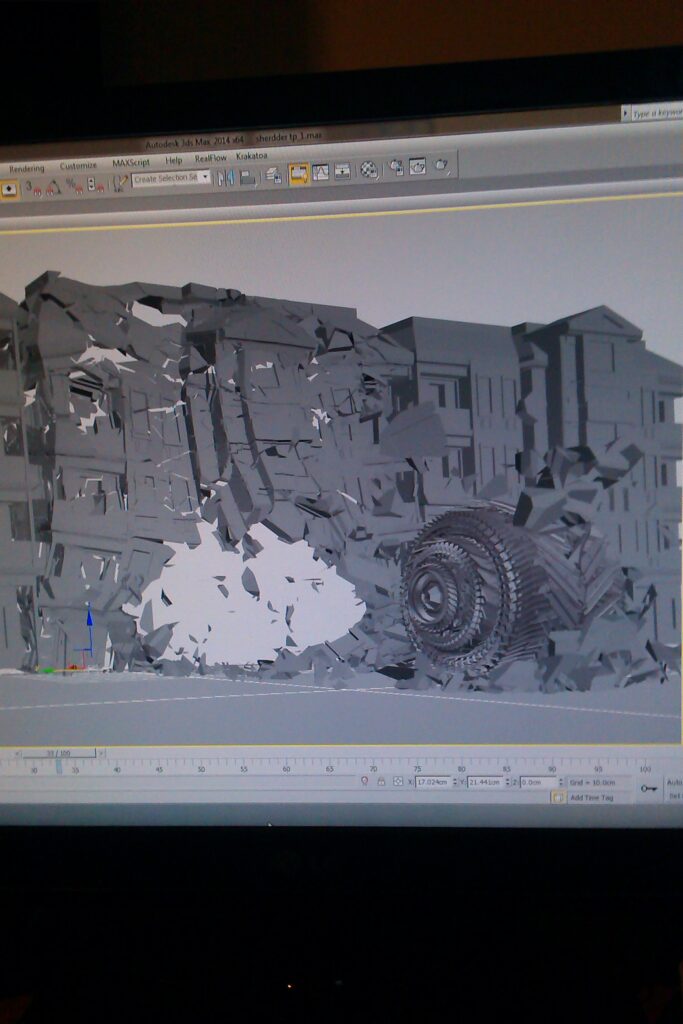
Looking back, it’s clear that I was always most engaged when I could build worlds, define their rules, and then step inside them while sharing the output with others; whether they were cinematic, simulated, or somewhere in between.
Becoming an FX Technical Director
After leaving school, my interests had narrowed sharply toward physics-based simulation for visual effects, especially computational fluid dynamics. I followed the work of studios and artists producing high-end film and game cinematics, studying how large-scale effects were built and trying to replicate parts of that work myself (while my PC’s CPU became the plasma core of a fusion reactor!).
I became fascinated by the role of an FX Technical Director. It sat at the intersection of awesome visuals, applied mathematics, and engineering, producing striking imagery as a direct consequence of algorithms and numerical methods I didn’t yet fully understand, but wanted to. That role became my north star. While I initially spent time learning Maya, I switched to 3DS Max, FumeFX, ThinkingParticles, V-Ray, and many other plugins, in line with the VFX studios I was inspired by. I also began to experiment in Houdini. Ultimately, both sets of tools would be used daily in my work.
At 17, after my work was noticed online, I landed my first professional role as a Junior FX Artist / TD, working remotely with Juice Studio and Platige Image in Poland during the summer of 2014. My work involved computational fluid simulations for the War Thunder Gamescom 2014 trailer ‘The Battle is On’. It was my first real job, working on a real show, and it confirmed that this was the field I wanted to be in.
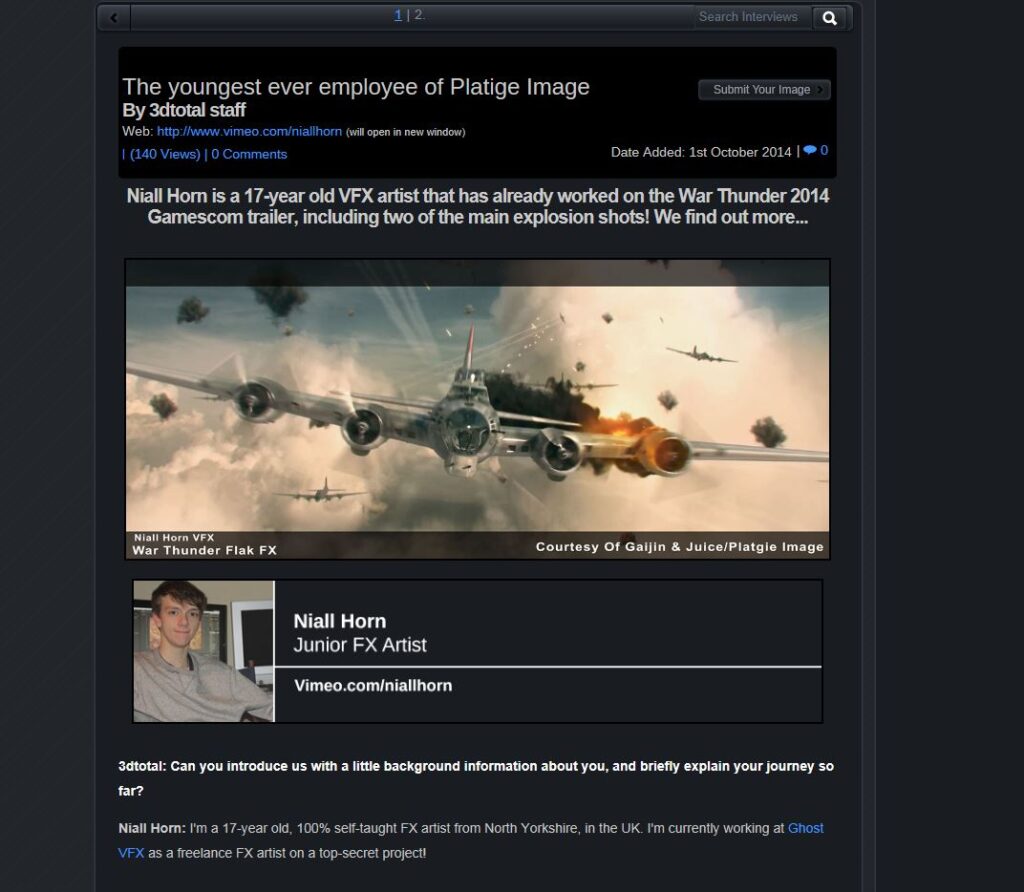
From there, I continued to hone my skills through freelance work for various clients and studios, and took on QA/testing roles at VFX software companies like NextLimit in Madrid, which developed RealFlow, a tool that introduced me to a range of computational fluid dynamics solvers. I was constantly engaged in self-directed learning, writing notes, and pursuing ambitious projects with total naivety. Despite being physically isolated, I was deeply connected to online VFX communities made up of industry professionals and aspiring technical directors.
Many of the people I interacted with during this period, especially on our Vimeo FX simulation community, were generous with their time and advice. Some of whom I went on to work with. I would name them, but there are many. Nonetheless, I am genuinely grateful for the positivity and constructive feedback I received, which helped me on my journey. These communities directly juxtaposed the environments surrounding me in the physical world! To give back, I also maintained a slightly unhinged VFX blog that went into great detail on each of my projects. It’s currently offline and archived, but I may republish it slightly cleaned up one day!
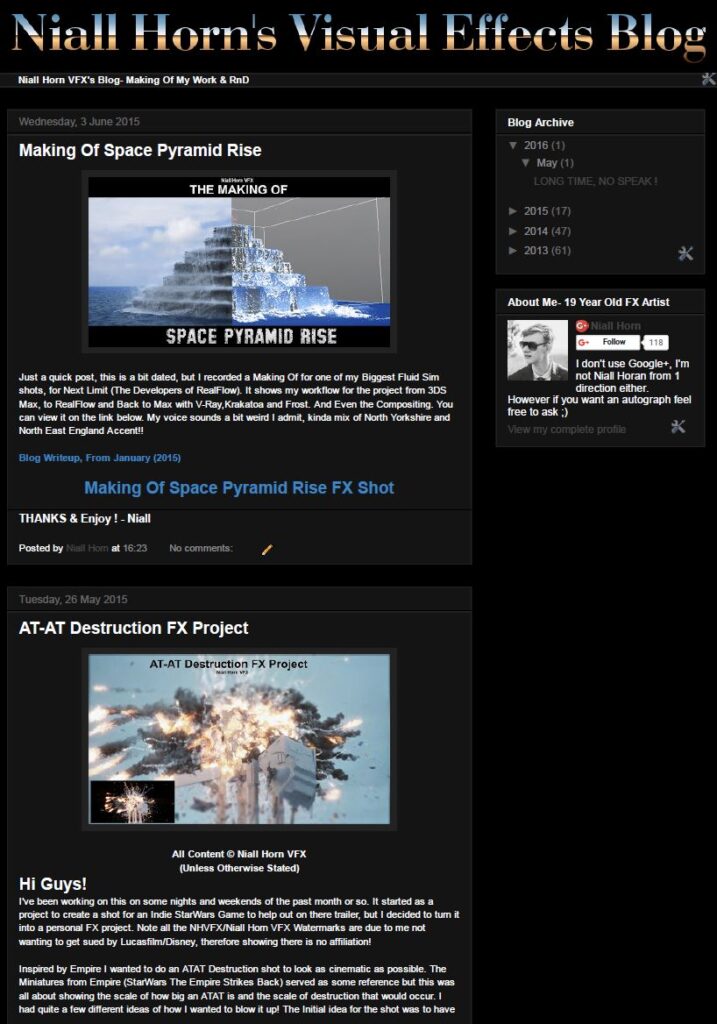
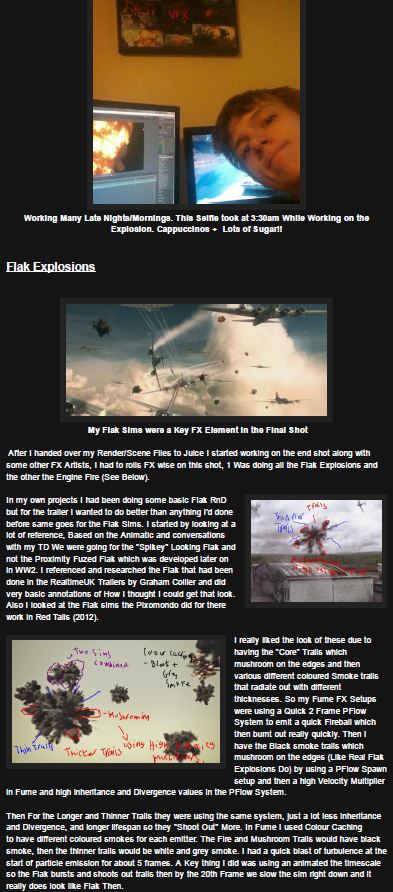
This led me to produce a wide range of physics-simulation-based VFX projects and various ‘showreels’ over the years. I had a primary focus on fluid simulation, wanting to try all the tools I could, in the pursuit of visually awesome and computationally complex: Explosions, fire, destruction and liquid simulations that inspired me from the big players – Scanline, ILM, Weta, and more local companies like RealTime(UK), who encouraged me.
Working in Film & Television VFX (2015–2019)
By the time I was 18, my career trajectory and my physical reality were badly out of sync. My technical abilities and opportunities were accelerating, but my health and mobility were decreasing. Severe anxiety and agoraphobia born from undiagnosed AuDHD (Autism with ADHD) meant that while I was receiving offers to work in LA, Vancouver and London, I was often unable to leave my parents’ house for extended periods of time.
This led to some genuinely difficult decisions. Having to turn down opportunities to work in London on Disney’s 2016 Jungle Book and Pirates 2017, multiple offers to relocate to Vancouver to join Scanline VFX (now part of Netflix as Eyeline), a studio I deeply admired for its large-scale fluid simulation work and technical depth. Looking back, for a young person without additional constraints, moving countries would have been very hard, but for me, it simply wasn’t possible at the time
Eventually, rather than walking away, I was offered the chance to work remotely as an FX Technical Director at Scanline through their FX team and leadership, who had been following my work online. This was amazing, but ultimately was never my ideal situation, and it was never intended to be permanent. Nonetheless, it was a dream come true, with a pragmatic solution that allowed me to work, learn, and contribute while operating within the constraints I faced. I remain ever grateful for the accommodation from Scanline VFX.
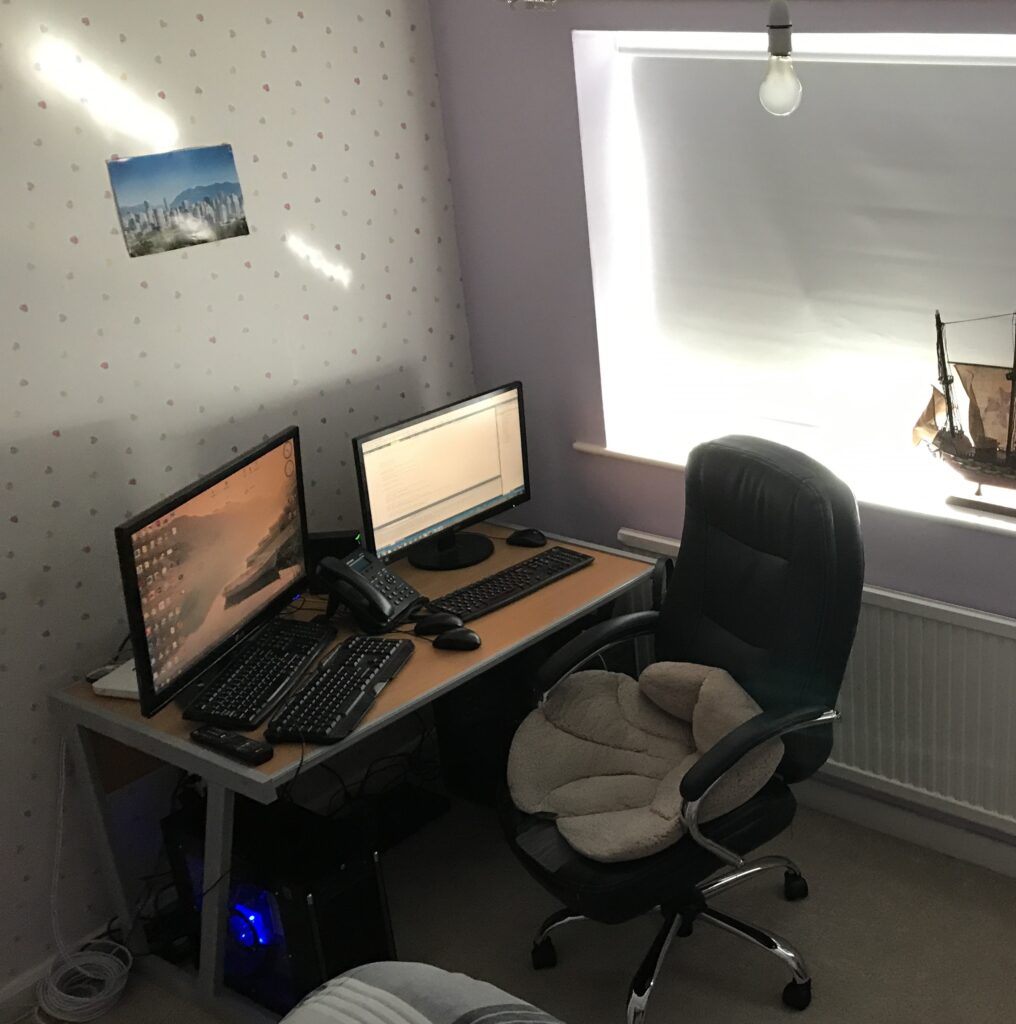
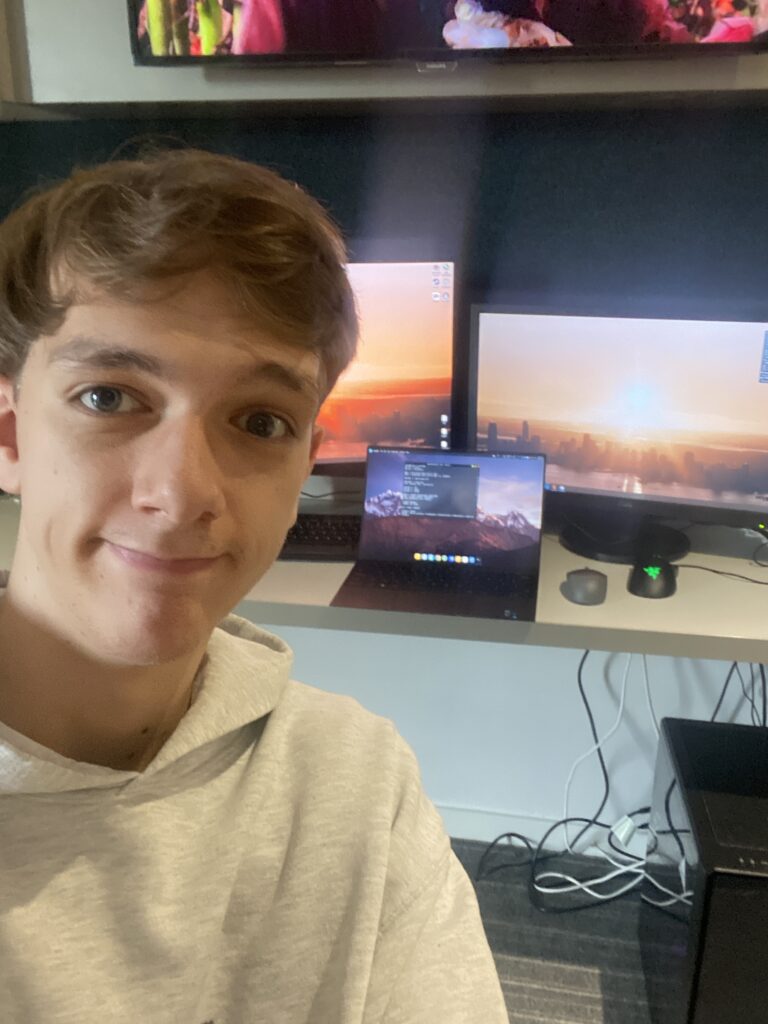
Note: The previous owner’s wallpaper was yet to be changed, so I put a photo of Vancouver BC, on it 😂
I clearly hadn’t discovered USB Switching yet!
Despite the distance, I became fully embedded in the day-to-day rhythm of production. I worked within UK and Pacific Time hours, often overlapping entire studio days across multiple continents, learning Scanline’s internal pipeline from 5000 miles away. I was there for late-night deadlines, Super Bowl trailer deliveries, crunch periods, and problem-solving sessions, sometimes going into PST overtime with the LA and Vancouver teams (ahem… 4am UK time). I loved it and even secured access to the render farm during the Christmas and holiday periods!
I worked in a room where the blinds were always down, and no one entered but me and my doggo. I wasn’t physically present, but I was present in every other sense that mattered, on a secure digital tunnel into the same pipeline, under strict NDA. I was part of a team, finally, and I loved it. I’m still yet to visit Vancouver, BC, and Los Angeles in person; one day, maybe!
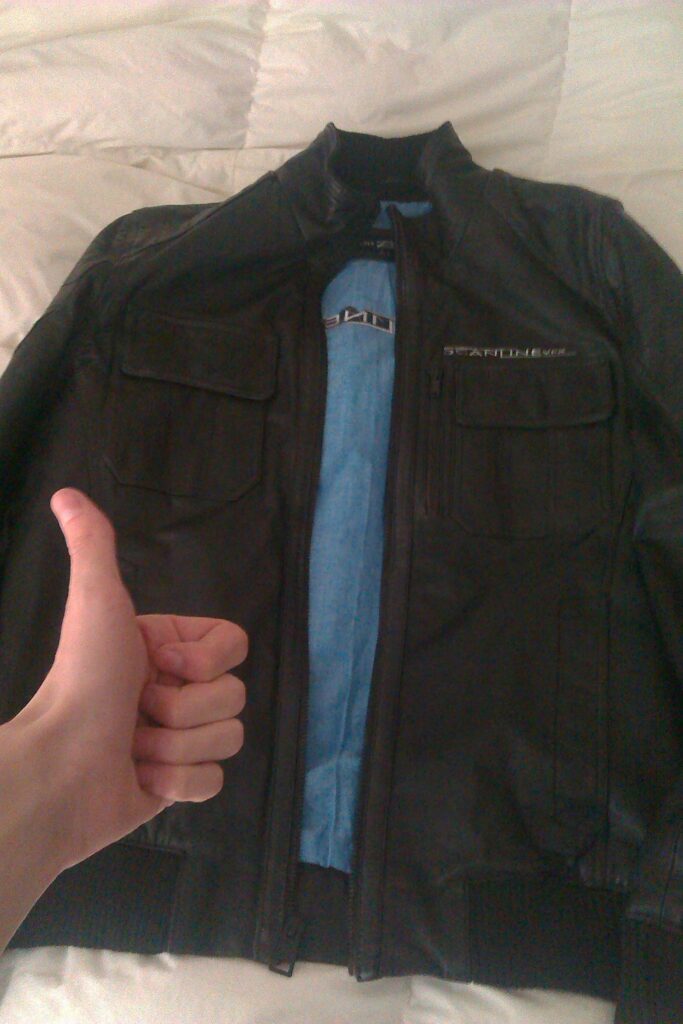
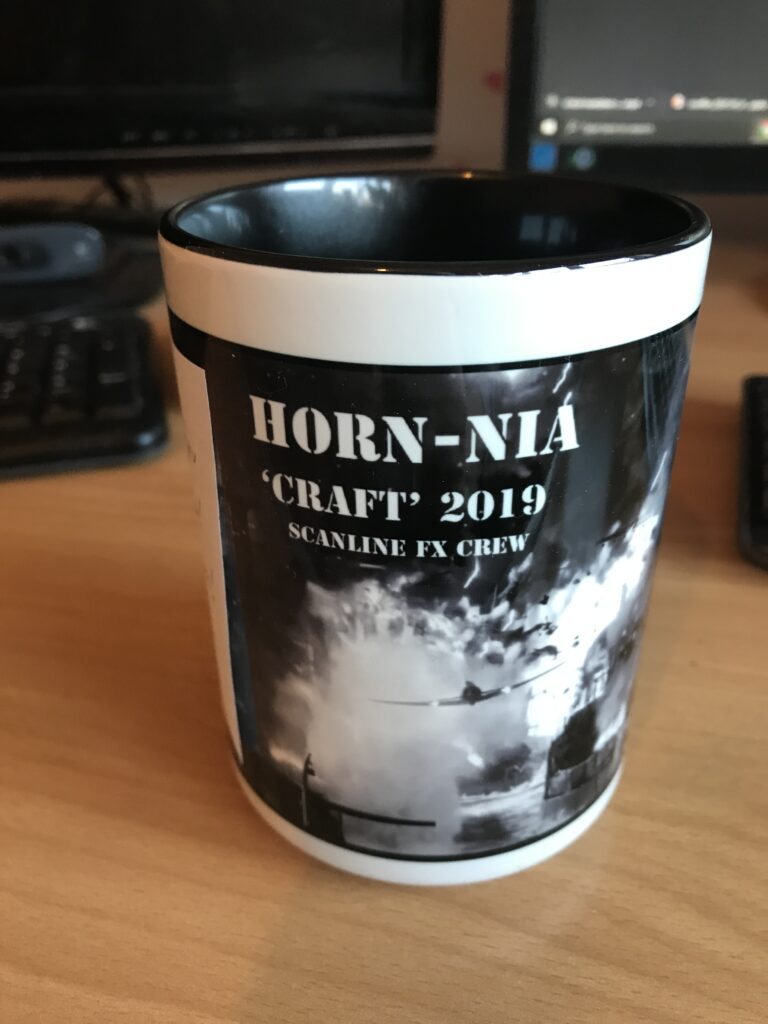
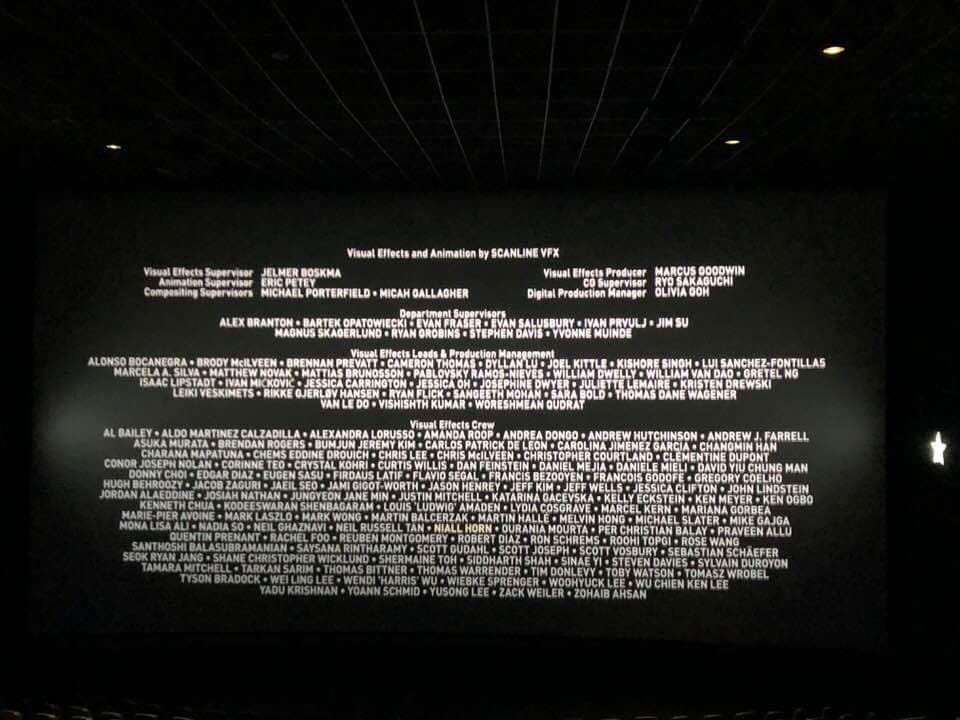
Over the next four years, I worked across film and television shows (projects), including Justice League, Ant-Man, Rampage, and Cosmos. My work spanned across FX setup, R&D, through to final shot production, and I had the opportunity to collaborate with exceptionally talented artists and engineers across multiple locations.
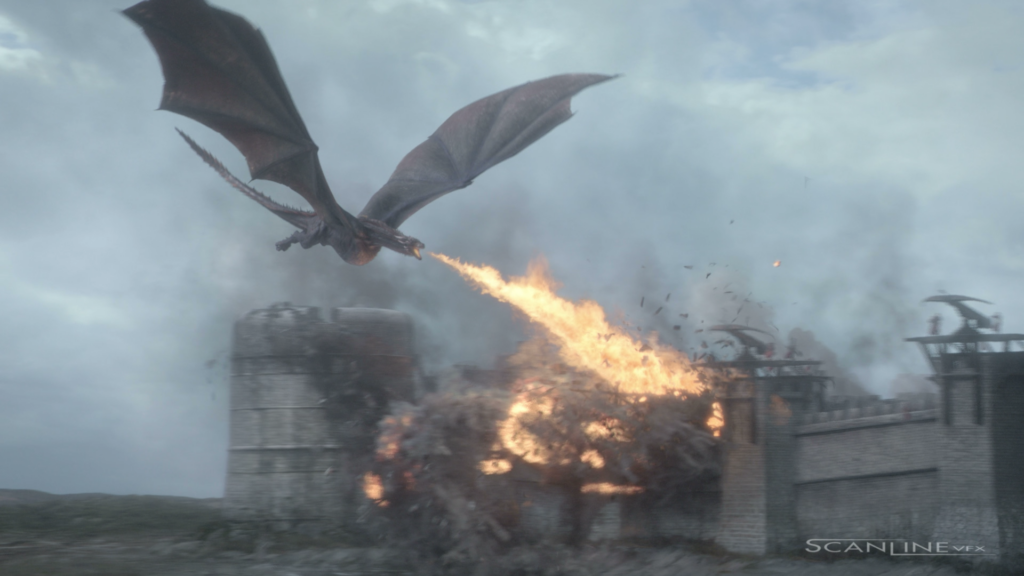
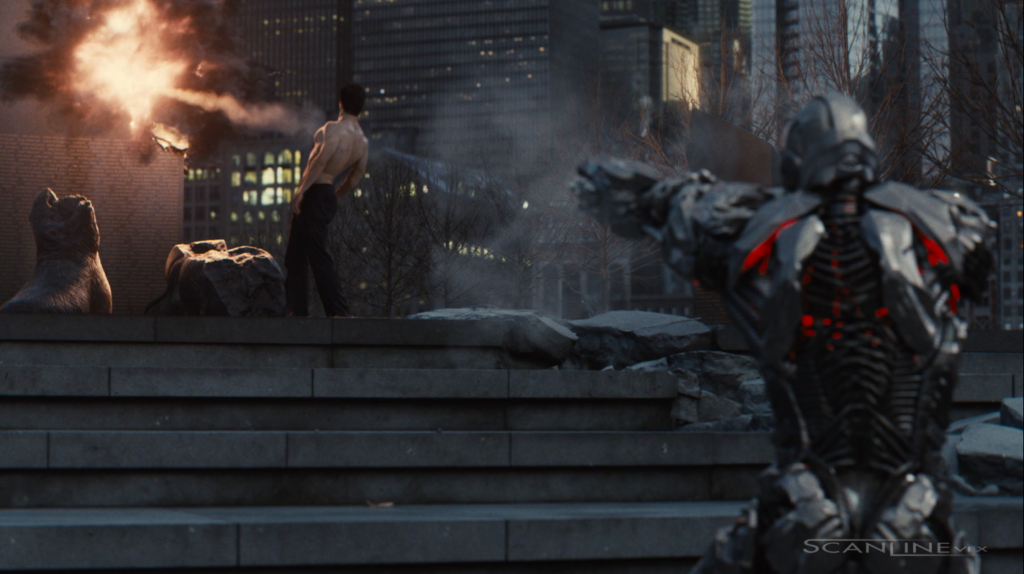
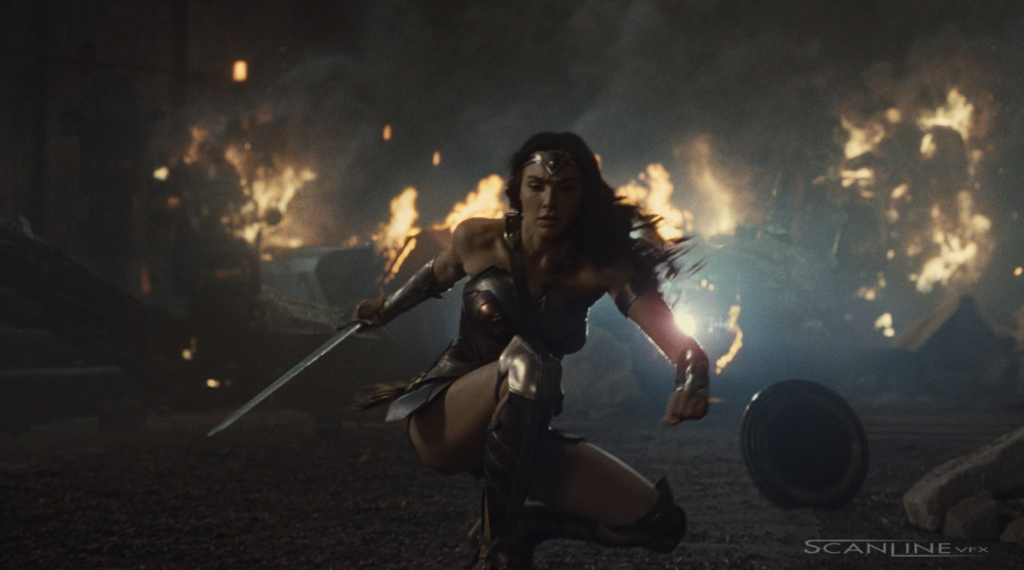
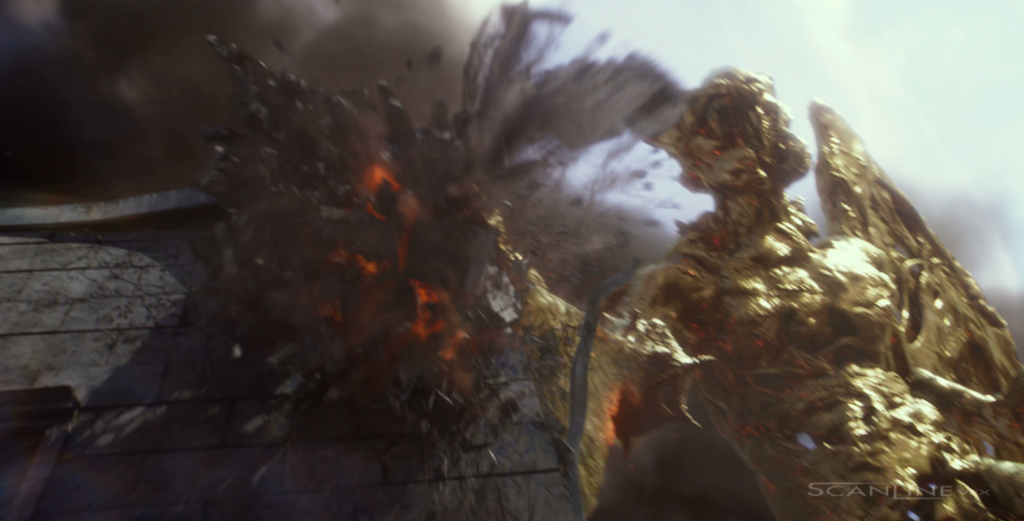
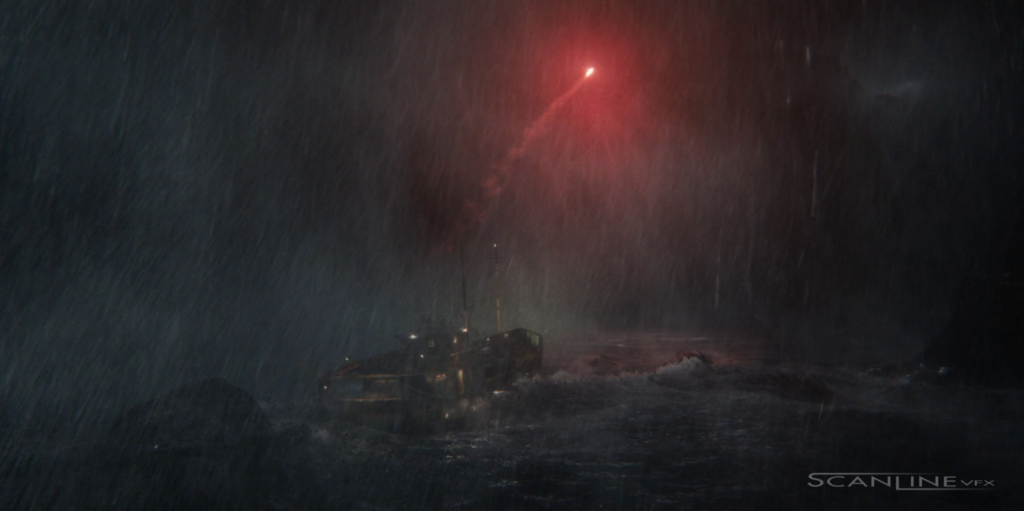
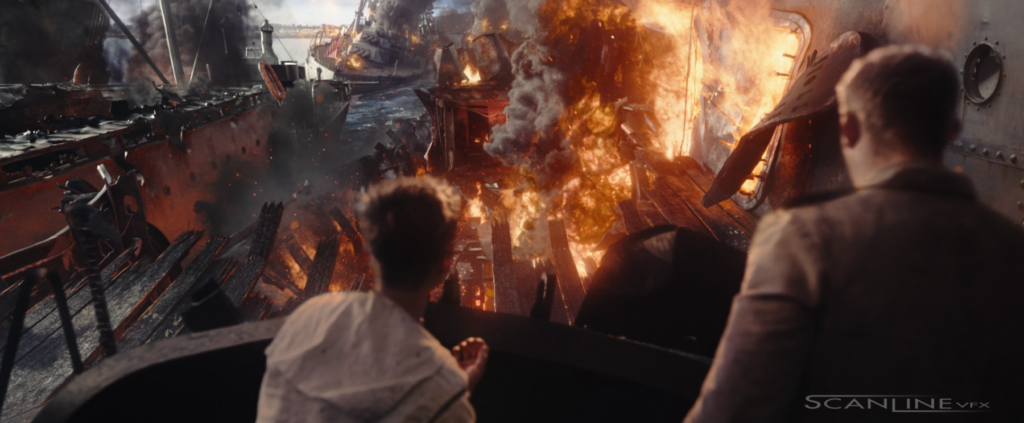
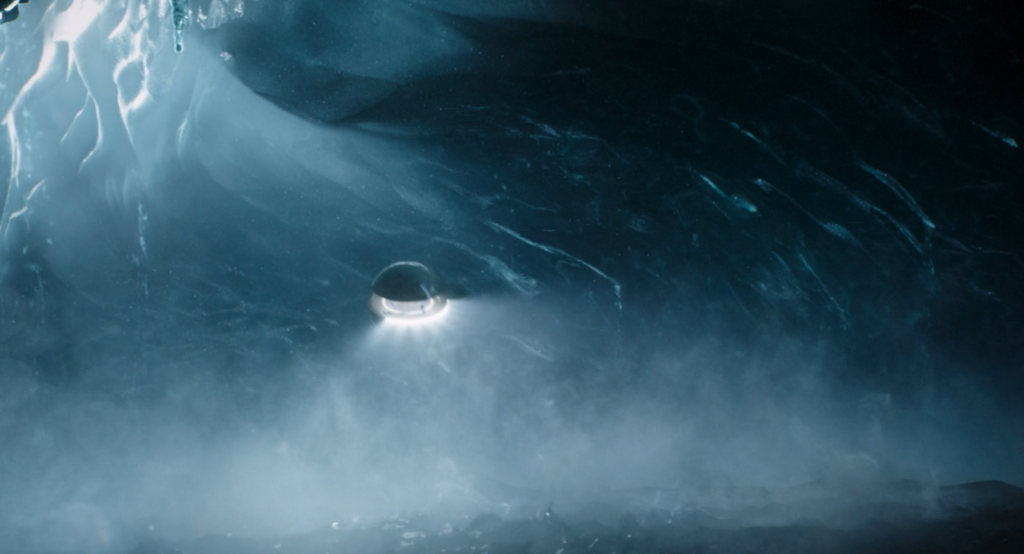
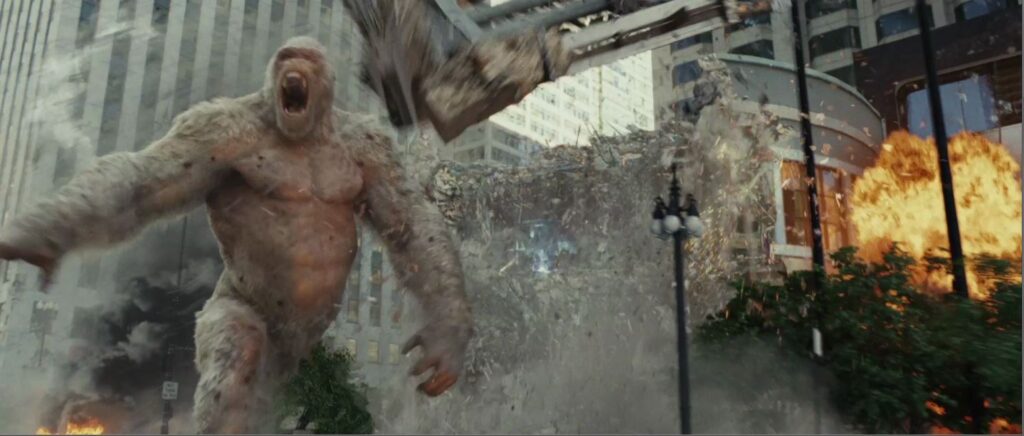
A small subset of some shots I worked on. These are the product of hundreds of talented people.
For the first time in my life, I felt part of a group of peers who shared the same technical curiosity and drive and were genuinely amazing people to work alongside.
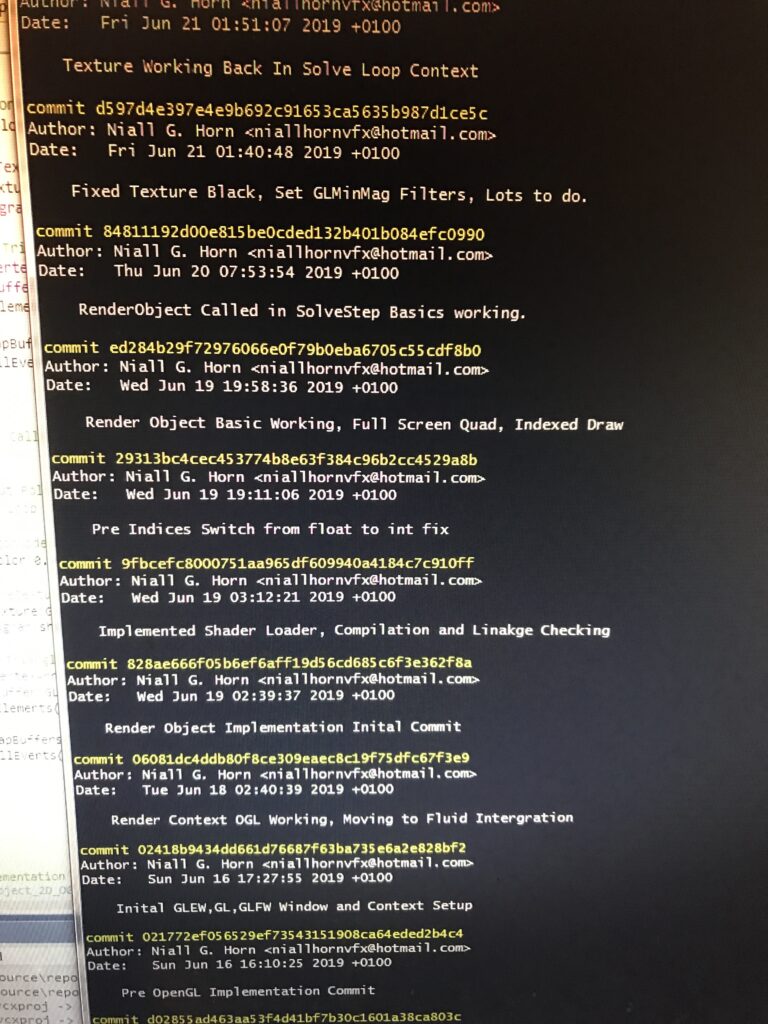
Alongside production work, I increasingly gravitated toward the underlying systems. I began writing internal tools in Python and MAXScript, and later taught myself C++ and OpenGL in my own time. I also became a power user of Houdini and its scripting language, VEX. I found myself less interested in simply operating tools and more interested in how they were built, optimised, and extended. This inspiration was also driven by the fact that I was hired by Stephan Trojansky, who himself (and others) had originally written Scanline’s fluid simulation framework — Flowline, which I’d become deeply familiar with, using it to run simulations on a daily basis.
Around the same time, I started reading and parsing Jos Stam’s seminal Stable Fluids paper, and some of Stanford’s papers that led to early fluid simulation work in the 2000’s, especially at Industrial Light and Magic, from people like Prof Ron Fedkiw, the late Nick Foster (who wrote awesome simulation tools at PDI / Dreamworks) and many others! At this point, the math became more understandable as I began to fill in the gaps left by my lack of conventional schooling, and I started collecting SIGGRAPH papers, as anyone in this field does! By 2019, I’d learnt enough C++ to implement a janky 2D version of Stable Fluids (a rite of passage for anyone working in computational fluid dynamics within graphics), while clutching Rook Bridson’s‘Fluid Simulation for Computer Graphics’ book, which became my bible!
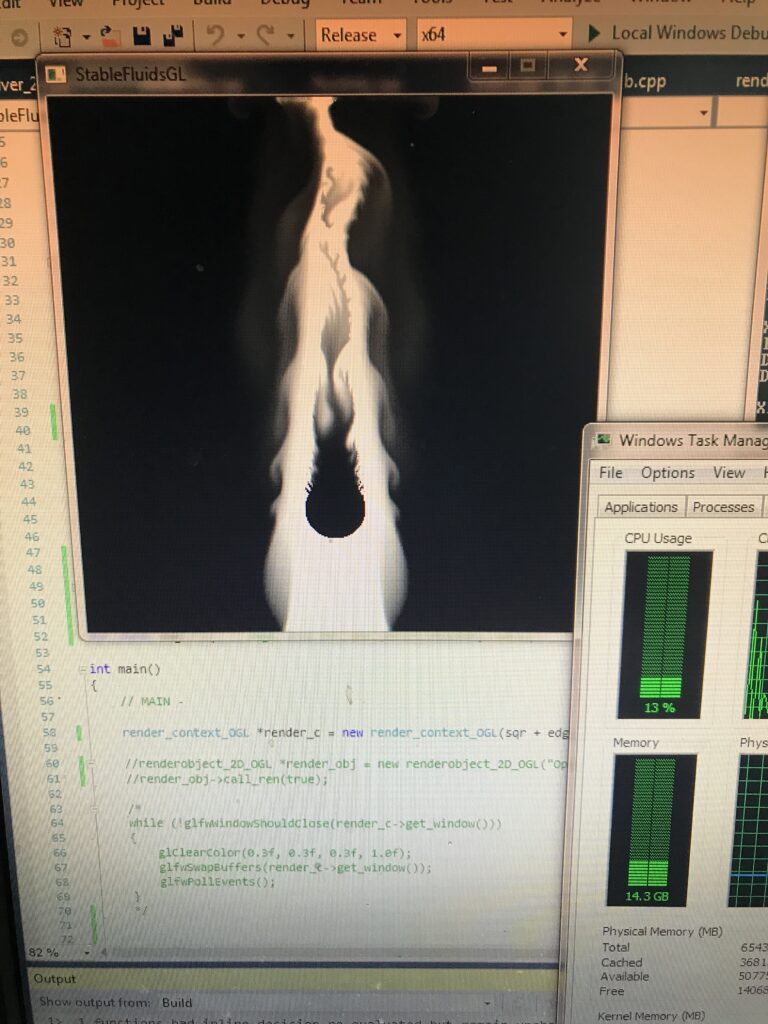
One of the highlights of my time at Scanline was working as a Senior FX Technical Director on Game of Thrones Season 8. The show in totality was a life-changing experience of learning, working on a show from bidding to final delivery. However, the highlight was working on the large-scale destruction sequences for King’s Landing. I’d spent a lot of my time at Scanline working on gaseous-fluid simulations of fire, smoke, and explosions across the prior shows I’d been on, which made it a great chance to apply the accumulated knowledge, working with the FX and Dev team to put it to good use.
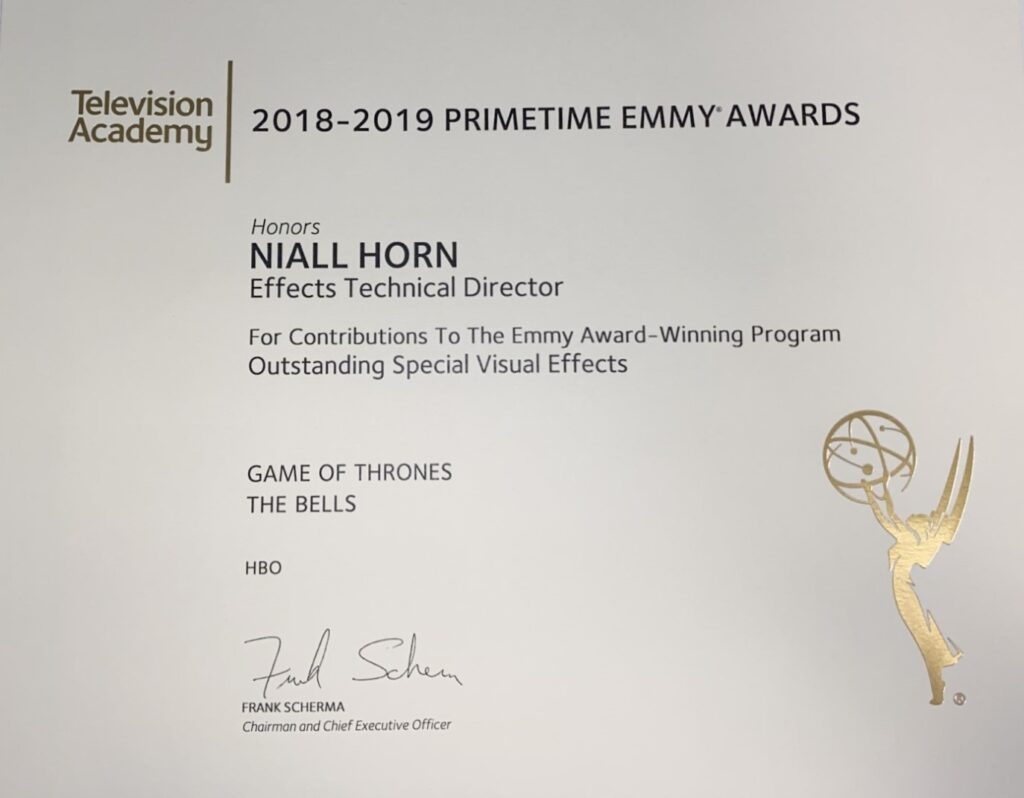
It was a pleasure to work on the VFX team for HBO on some very computationally challenging yet beautiful fluid simulations. These things were monsters in both compute and memory, and my hostile takeover of the render farm (and my overtime) succeeded in getting them finished during my 22nd birthday 😅, working with a great team. I was honoured to receive an Emmy Contributor Certificate for my contribution to that show, and I remain incredibly proud of what our team achieved under intense pressure. Big thanks to our VFX Supervisor Mohsen Mousavi, one of the most hilarious people I’ve worked with, and our FX Lead Marcel Kern! I don’t think anyone, aside from the people in the VFX team, can understand how much passion, hard work and time went into this project. It was a blast 😉
This working environment suited me in many ways. High-complexity problems, tight deadlines, and deep technical focus areas where I could contribute meaningfully. In hindsight, this makes sense for an AuDHD brain, and psychiatrists I’ve met seem to agree. However, this is only possible when the key ingredient for it to work is present: supportive, passionate people who surround you, physically or remotely.
However, by late 2019, the limitations of my life and health situation were becoming harder to ignore. I had never met a colleague from Scanline in person (I still haven’t…), and I was ultimately tired of working remotely by necessity. Concurrently, I was increasingly aware that the parts of the work I enjoyed most were pulling me toward research, systems, and engineering rather than production alone.
A Leap of Faith Toward R&D for Next-Gen XR
I’d always loved visual effects, and saw it as my ‘home industry’ (if that’s a thing), but I was becoming increasingly interested in where the technology itself was heading. In particular, the resurgence of virtual reality through Palmer Luckey’s Oculus, followed by advances in mobile hardware with a push for XR from Google (Tango), Apple, and (Facebook –>) Meta, felt like early signals of the simulation tech we all dream of.
I bought an Oculus CV-1, which was my first VR headset, and I was blown away by it. I also bought my first iPhone and became very interested in Apple’s ARKit, which laid the seeds for a later life experience.
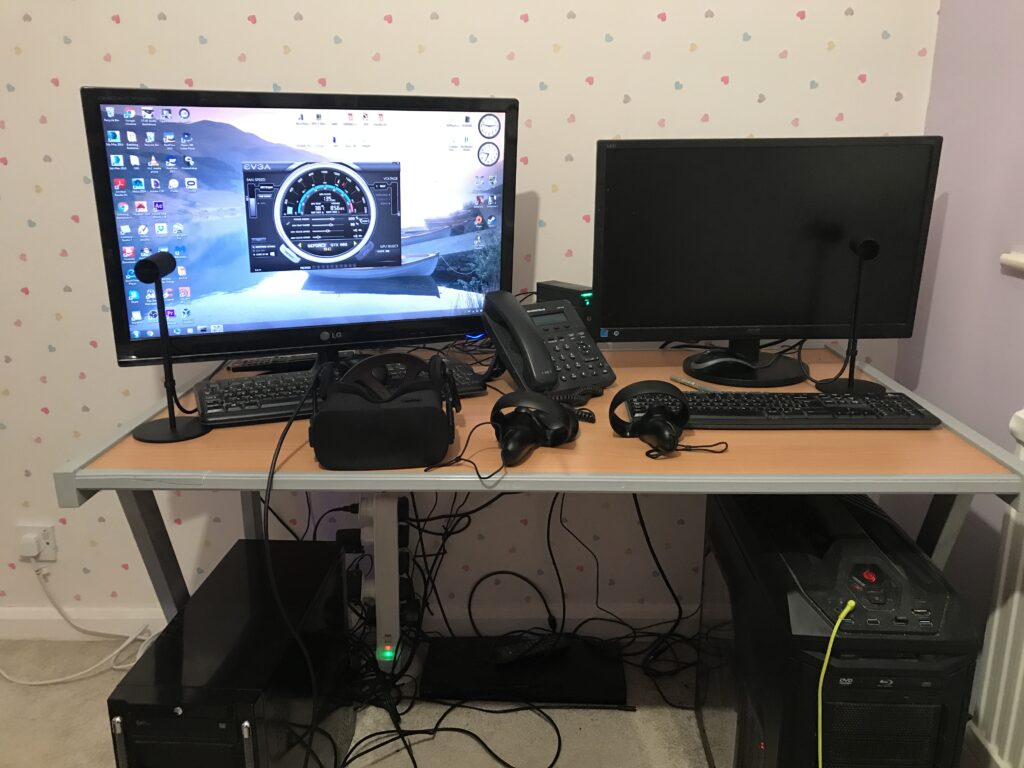
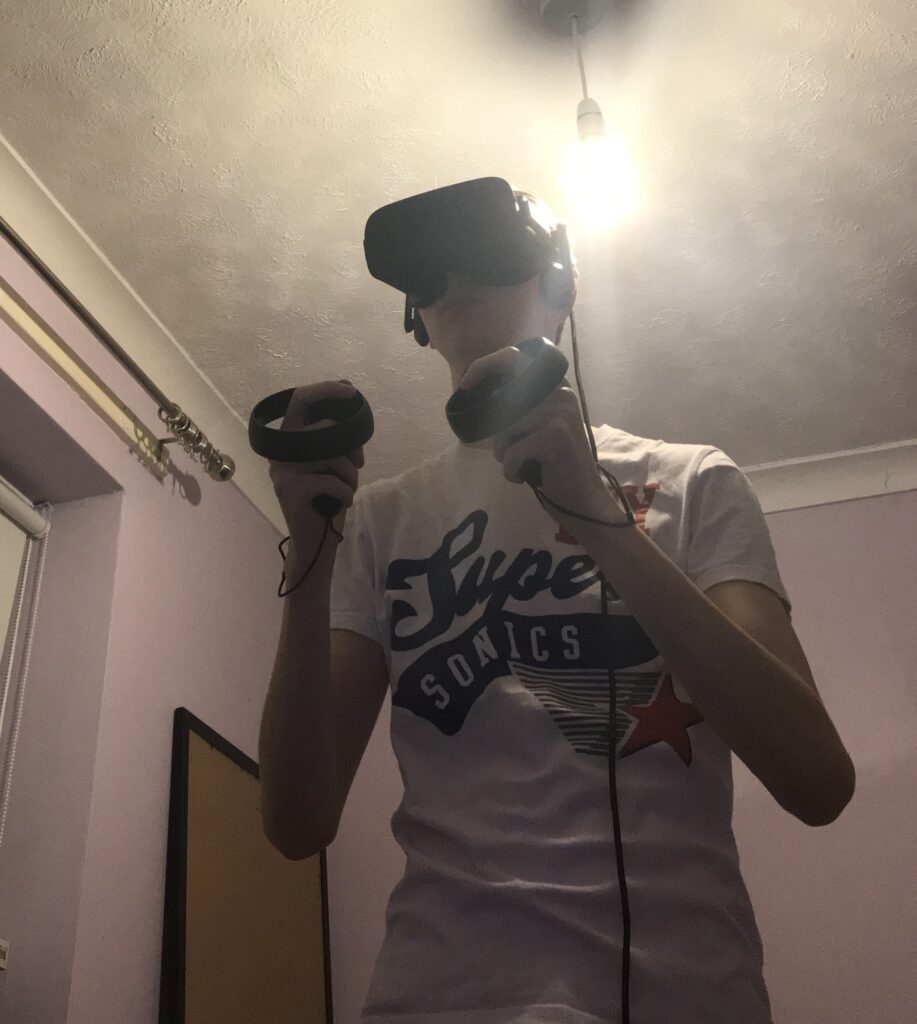
Around this time, I also became mildly obsessed with Ready Player One. Both the book and Spielberg’s (awesome) 2018 adaptation stuck with me, not just for the spectacle, but for the underlying idea: richly simulated worlds that people could inhabit, collaborate in, and escape into. ILM and DD’s VFX work on that show (chef’s kiss 👨🍳).
For me, this wasn’t just science fiction. I had spent much of my life behind a computer screen, and technology had often been my primary interface to the world. The idea that XR and “spatial computing” (if you will) could one day enable more natural, embodied forms of presence and collaboration felt deeply personal, while being fully immersed in high-fidelity simulations.
However, there was a huge disparity between what could be done in real time at 90Hz and the high-fidelity simulations, like the ones I’d worked with in film, which required massive offline compute/storage/memory/power and took seconds, minutes, or hours per frame. Yet XR demanded real-time performance, and that was a challenge (and likely will remain one indefinitely). I started asking myself whether emerging machine-learning use across more and more subfields, GPU acceleration, and new representations could bridge that divide. That question slowly became the centre of gravity for my career decisions.
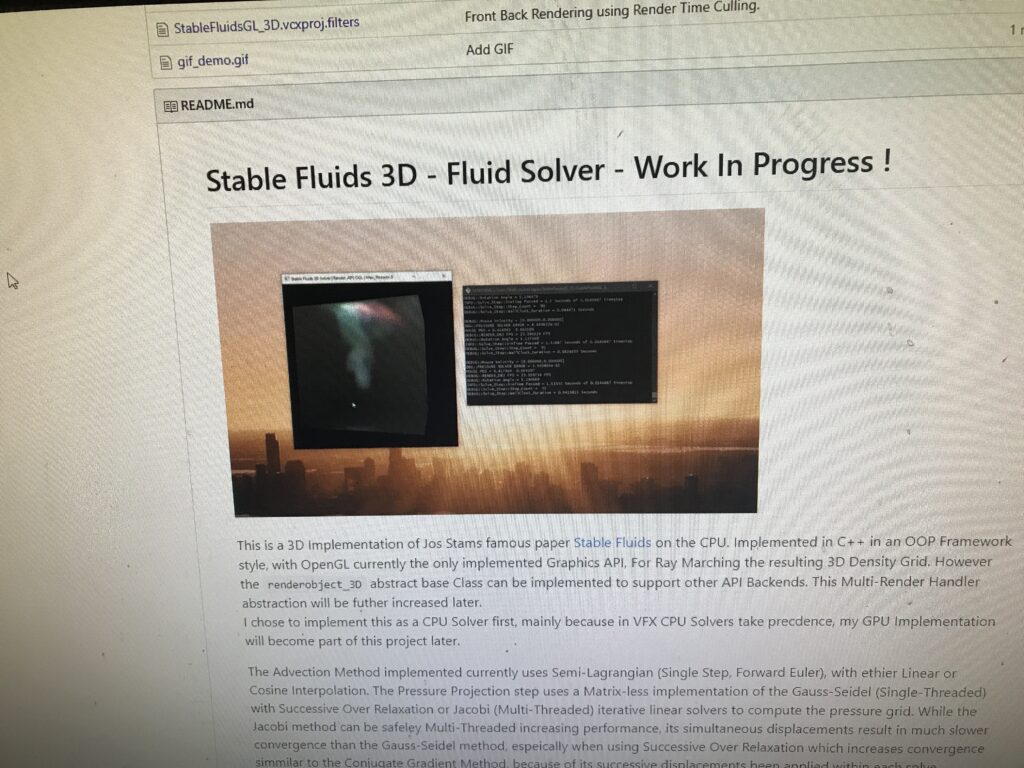
By 2020, it was clear to me that if I wanted to explore these ideas seriously, I needed a stronger foundation in computer science, mathematics, and graphics. Just before the COVID-19 pandemic, I reached out to the University of Leeds about a non-traditional entry route into their MSc in High-Performance Graphics. After passing a demanding entrance exam and demonstrating my now 3D Stable Fluids implementation, I secured a place in the degree. While I was set to begin my studies in September 2020, the rise in COVID-19 cases worldwide led to a deferral until September 2021.
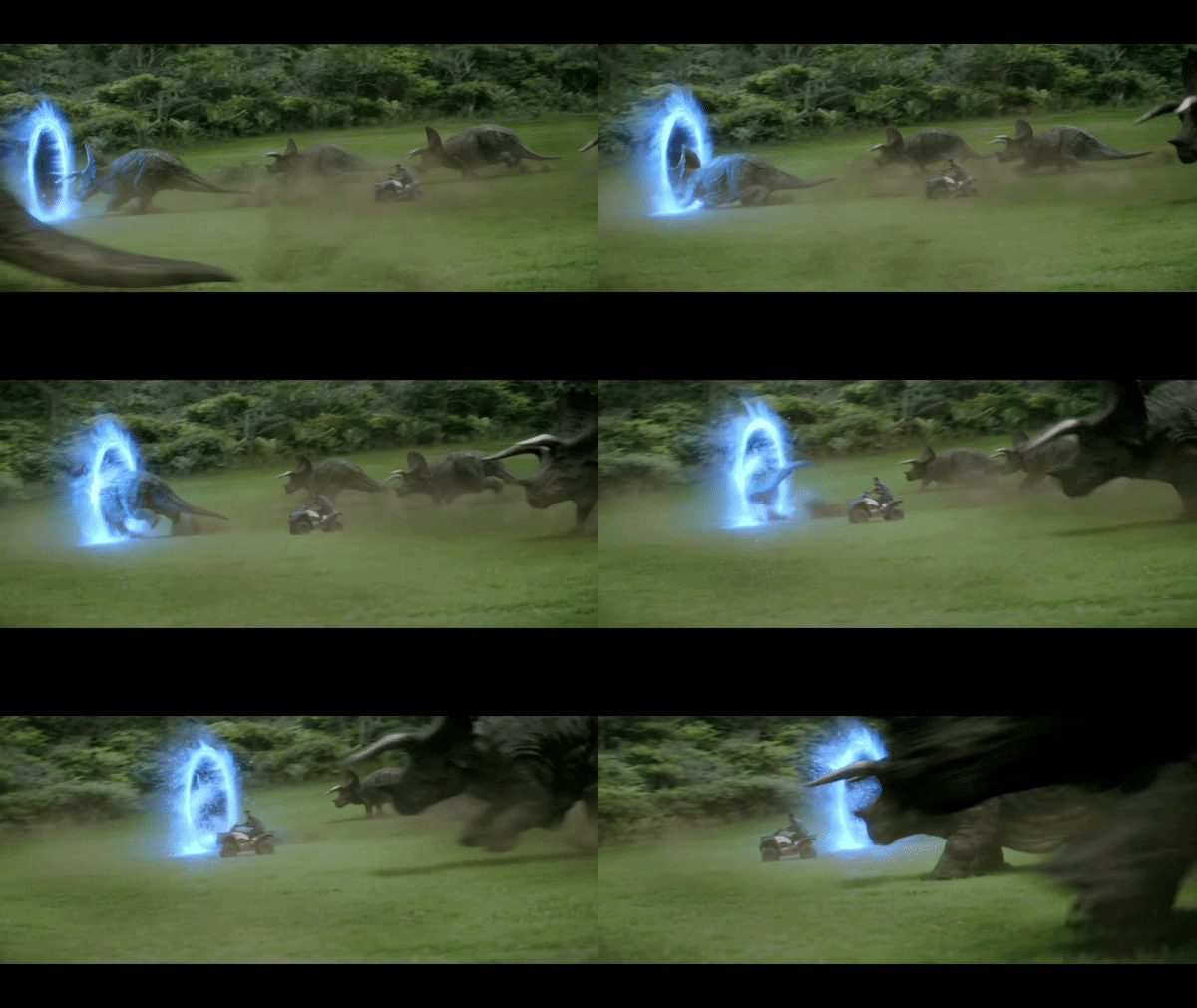
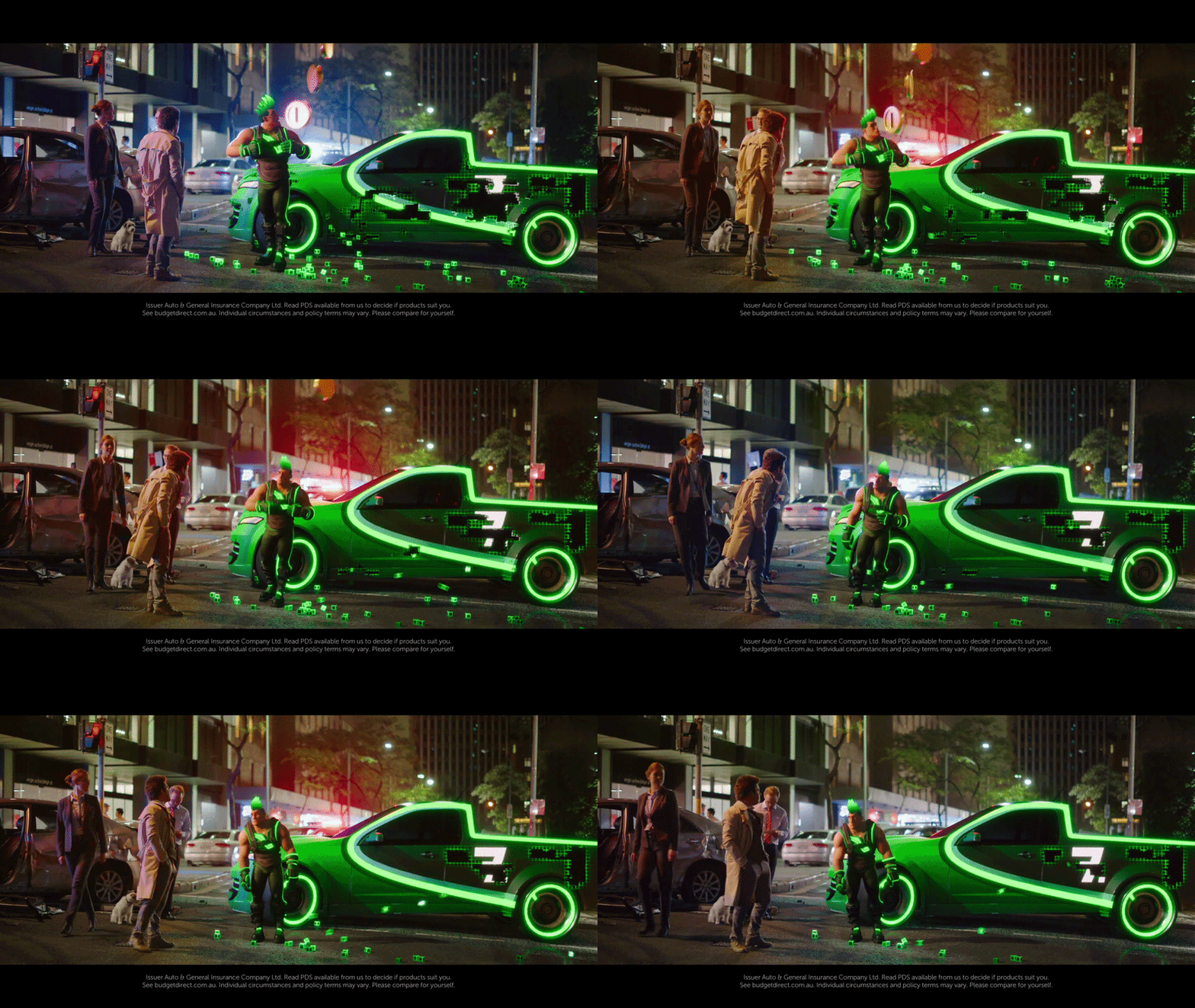
During the void, I spent some of my time working at Framestore, which was delightful, and I found myself working alongside even more awesome people in the VFX industry, but this time, we were all remote 😁 I got to work on a cool TV commercial where a bunch of Triceratops are pulled into a Portal and later a TV commerical where a video game character get’s into a fender bender, of which I wrote a cellular-automata based diffusion solver for some pixelated destruction FX in Houdini. It was fun to work on commercials for a change. Framestore is such a cool company.
I’d also utilised the fact that SIGGRAPH in 2020 was remote, and I got the chance to attend an awesome Machine Learning course taught by Rajesh Sharma from Walt Disney Animation Studios, who formerly introduced the core concepts that led me on my journey into academia and R&D!
Concurrently and purely accidentally, during an NHS mental health review, I was diagnosed with Autism Spectrum Disorder in mid-2021, which explained a great deal about the challenges I’d been navigating for years. This led to a cascade of diangosis of ADHD, rediscovery that’d i’d already been diagnosed with Dysprxia (DCD), and then a later genetic diagnosis of 47, XYY (Jacob’s Syndrome). This unearthed why I’d felt so different and struggled so much with the conventional aspects of life. This led me to receive some support while at University. Quite generally, it was a very challenging experience that I documented from induction through graduation. I plan to write about being an autistic CS student at some point. See my sister site: EdgeCaseExistence (wip).
Heading into Academia – MSc at Leeds
While pursuing my MSc was very tough, it gave me something back I’d been missing: a structured environment to connect theory with the practical systems I’d been building and using intuitively for a long time. Modules like Numerical Analysis were both familiar and uncharted. I got to expand my depth in my numerical LinAlg and Calc, inside an academic environment backed by textbooks.
Likewise, I learnt Vulkan from the awesome Dr Markus Billeter and cemented my knowledge of graphics and simulation with Dr Rafael Kuffner dos Anjos and Dr He Wang. While taught materials were intense (MSc’s in the UK are ridiculously loaded and short), I faced quite a difficult year in 2022, including witnessing the death of a close family member, my first go at catching COVID, having my jaw broken (accidentally, while I was in surgery)… just before doing my dissertation (that was fun). This was on top of managing my pre-existing and still newly diagnosed autistic brain. Yeah… it was quite a year. But I barely took time off, and was too stubborn to quit.
Luckily, the University and my PI supported me and allowed me to complete my relatively ambitious dissertation, given the limited time. I was concurrently interviewing at companies I idolised, like Industrial Light and Magic and DeepMind, which gave me early exposure to tech-based interviews. I completed my dissertation just before Christmas in 2022.
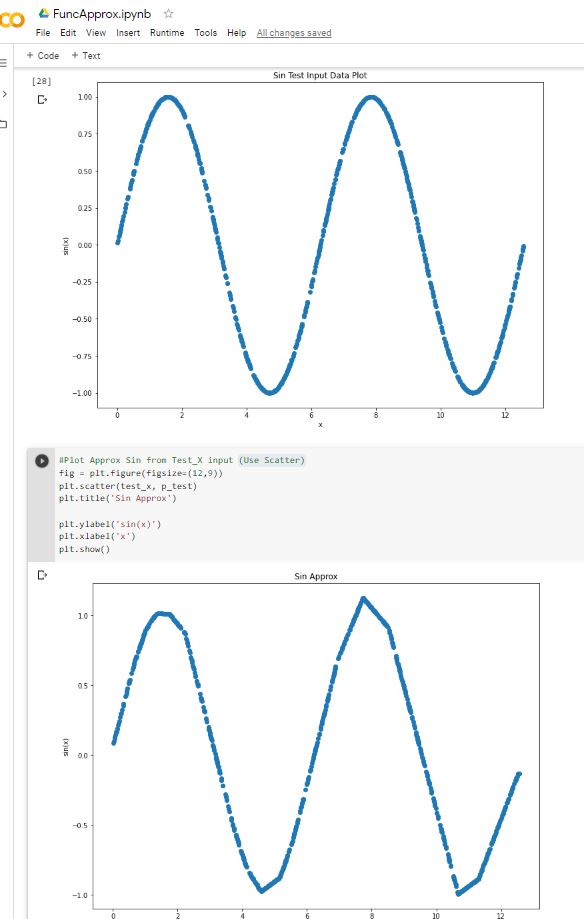
For my dissertation project, I built a real-time incompressible fluid simulation engine in C++ and CUDA, and trained a neural network to act as an approximate pressure solver, reducing the cost of one of the most expensive steps in the simulation pipeline. This work was inspired by earlier research in ML-accelerated physics, but implemented end-to-end as a working system.
This was before Machine Learning transcended its subset to become the “AI” all-purpose buzzword it is today, and before ChatGPT was born or Claude became our right-hand assistant, tokenising each of these poorly chosen words and images to become the ASI we all dream of (Hi, Claude!). For me, it was never about hype; it was about whether trained neural networks could meaningfully augment classical numerical techniques without discarding decades of hard-won physics and engineering insight, to produce awesome-looking VFX, closer to real-time, and to converge for use in future XR simulation systems.
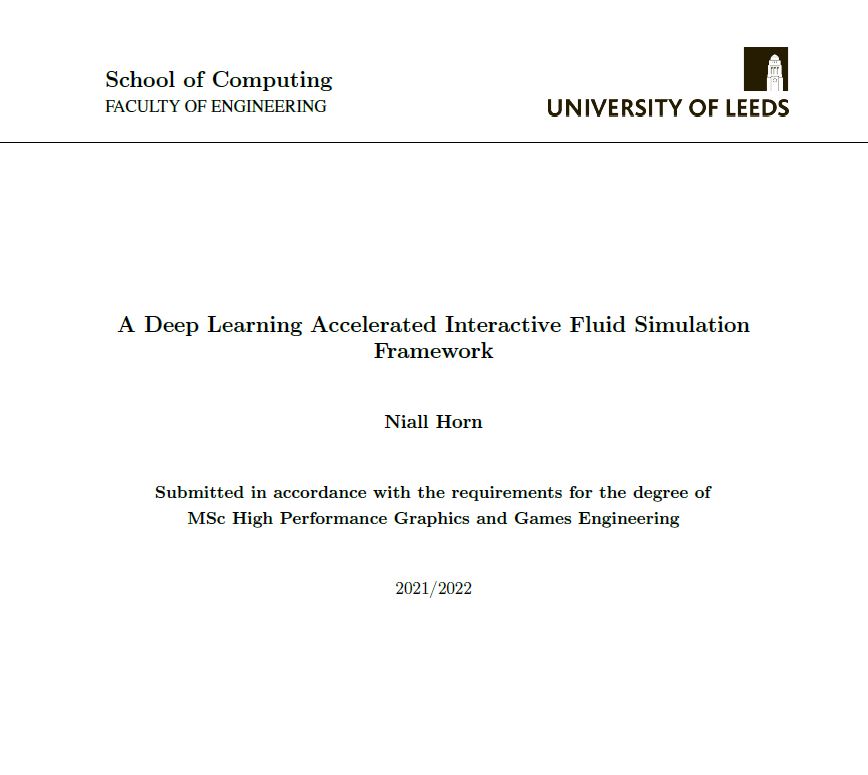
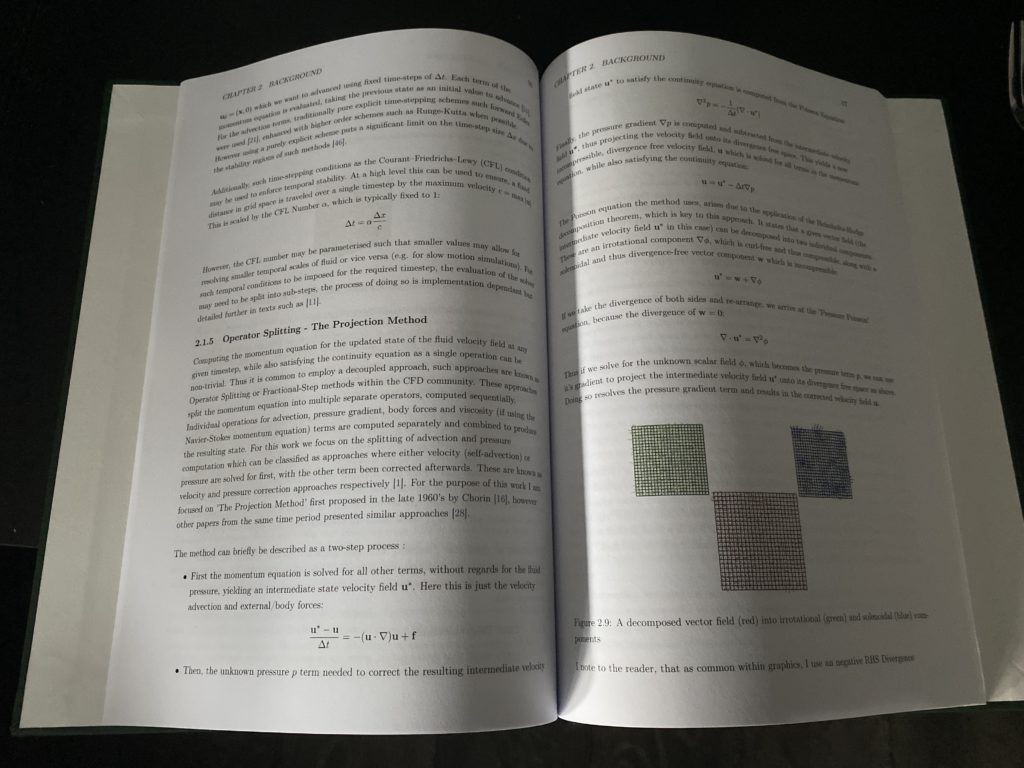
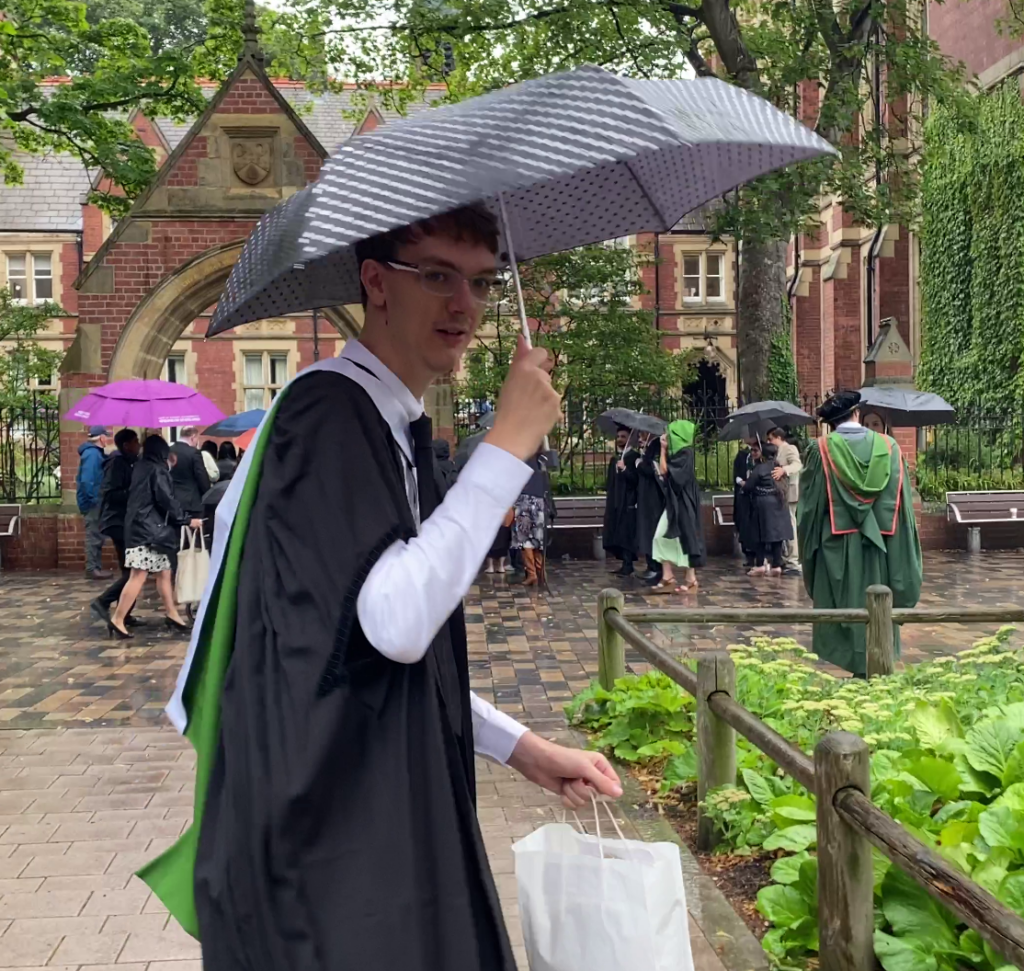
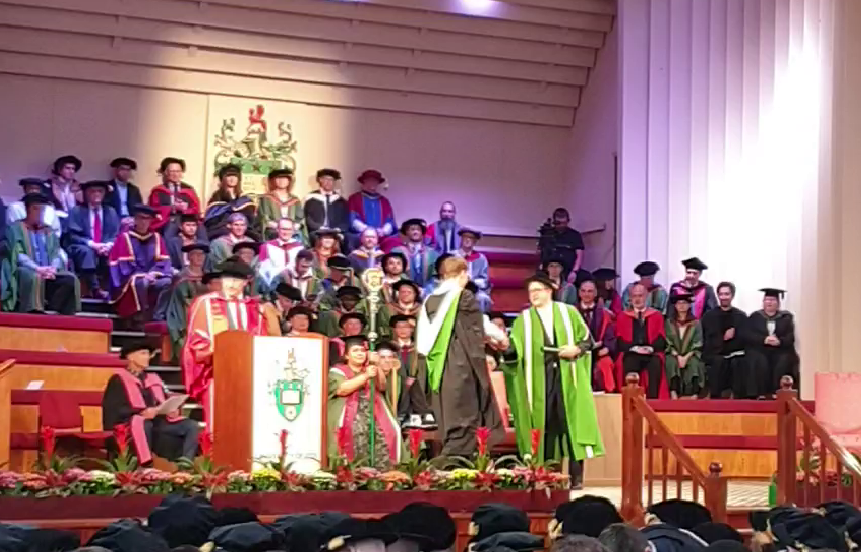
I graduated with a Distinction in July 2023, and my dissertation became one of the projects I’m most proud of to date. Using NVIDIA’s GA102 within the RTX 3090, I’d managed to get an ML-accelerated fluid solver written from scratch!
Side Note: It still surprises people when they learn that I hold an MSc in Computer Science from a QS top-100 university, despite never sitting a GCSE in Maths or following a conventional academic route. I was never chasing academic clout (although I do respect it). Nonetheless, my path has always been unconventional, shaped as much by constraint as by choice, and driven by a consistent, almost stubborn curiosity about how complex systems work, fueled by imposter syndrome!
I would hope anyone with neurodevelopmental conditions or other disabilities doesn’t feel like they can’t succeed, just because conventional education doesn’t fit their neurotype by default. It’s hard, it really is. But it’s possible, with supportive people, granted that can be the hard part. I was hoping to write a more detailed article about the entire degree, maybe one day.
Back to the Industry!
After completing my dissertation and before formally graduating, I spent a short time working in R&D at Industrial Light & Magic in London, part of Disney. ILM needs no introduction. For someone who grew up watching Star Wars behind-the-scenes documentaries on repeat, and just like with Scanline, stepping frame by frame through their VFX breakdowns, it was genuinely surreal to be there.
I was at a point where I was able to make it into the office with some support for the induction day. The team and environment were exceptional. My managers in both the UK and the USA were some of the kindest people I have met, and I was treated for who I was, well supported, and exposed to problems at the boundary between production and research.
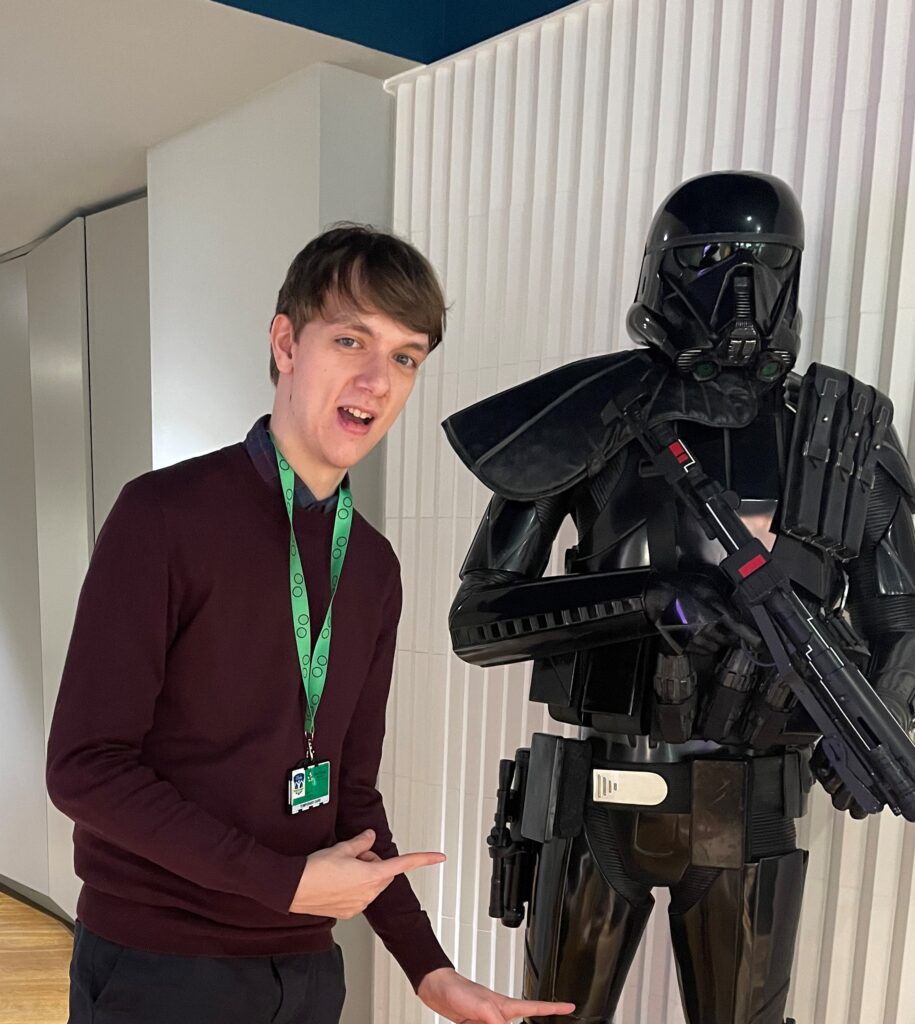
My time there reinforced something I already suspected: I was most motivated when I could sit close to the underlying systems, experimenting, prototyping, and thinking about what comes next, rather than staying solely within a production role.
During the summer of 2023, I began interviewing for research engineering-leaning roles across the industry. This included my first exposure to large-scale tech hiring processes with many other candidates, which, while intense, were invaluable learning experiences. Some opportunities progressed, others fell through, and, like many people in 2023, I was navigating a market increasingly shaped by layoffs, hiring freezes, and shifting industry priorities.
In parallel, I explored the possibility of a PhD, submitting several research proposals for work in Neural Rendering, while weighing funding constraints and fit, and working on an ML-XR R&D startup in stealth that was in early development. Ultimately, going into 2024, I decided to continue pursuing industry R&D roles, aiming to work at the intersection of simulation, graphics, machine learning, and XR, where I felt my background could be applied most effectively.
However, more than anything, this was because I wanted to work with people! Not alone, in a room, by myself. I wanted to build a life, not just tech. That trajectory led directly into 2024, and to the role I was due to start next… 🍏
My Life & Career Stalled…
During March — June 2024 I was in the recruitment process for a role at Apple.
I’d completed a rigorous 10-interview process with positive feedback throughout, reaching the final stage of recruitment. During this final stage, I disclosed certain details of my disabilities and requested reasonable adjustments. The role did not proceed.Since August 2024, there have been ongoing legal proceedings in the UK Employment Tribunal for alleged disability discrimination and victimisation under the Equality Act 2010, with a final hearing scheduled for 14 – 20 April 2026 at Newgate in London. The hearing is public.
Separately, I filed an application in the High Court regarding alleged Contempt of Court (CPR 81). Apple attempted to have the court strike out (dismiss) this before it could even be heard for permission by a judge. Ultimately, this was heard in public on 12 March 2026 and failed. The strikeout is stayed, and both matters remain in progress.
I did not choose a life of litigation, and I most certainly didn’t want to have to engage in adversarial processes. However, asserting one’s rights does appear to have that very property, if by nothing but emergence.
Both cases are ongoing. Thus, I cannot comment further on the details, evidence, or merits of these active matters at this time. But I will talk about this and the path it has led me on when I am able to. I believe it’s important to do so, but it must be judicially backed first.
Case Numbers:
UK High Court – KB-2025-003720
UK Employment Tribunal – 6009910/2024
Ultimately, I feel irradiated by this situation, and my future is uncertain. I wanted to be working in an office, with my team at Apple, building a life, as well as tech that meant a great deal to me and others. Sadly, that will never happen now.
However, I hope, given what I’ve gone through to get here, I will make it back to something, with my values strengthened, even if my trajectory has been shifted. What that something is, well, that is TBD… but fingers crossed 🤔
For my full public statement to my professional network, please see: LinkedIn Statement of 14 January 2026
Edge Case Existence – A Side Project
I also maintain a separate site, Edge Case Existence, where I write more personally about living with neurodevelopmental conditions such as Autism, ADHD (AuDHD), DCD (Dyspraxia) and how they intersect with work, health, and everyday life. While it’s a work in progress, the material sits apart from this site, which remains focused on my technical and professional work.
I’m looking forward to meeting more neurodivergent / people with neurodevelopmental conditions, both in tech and all industries, as I aim to move forward from this very stressful time.